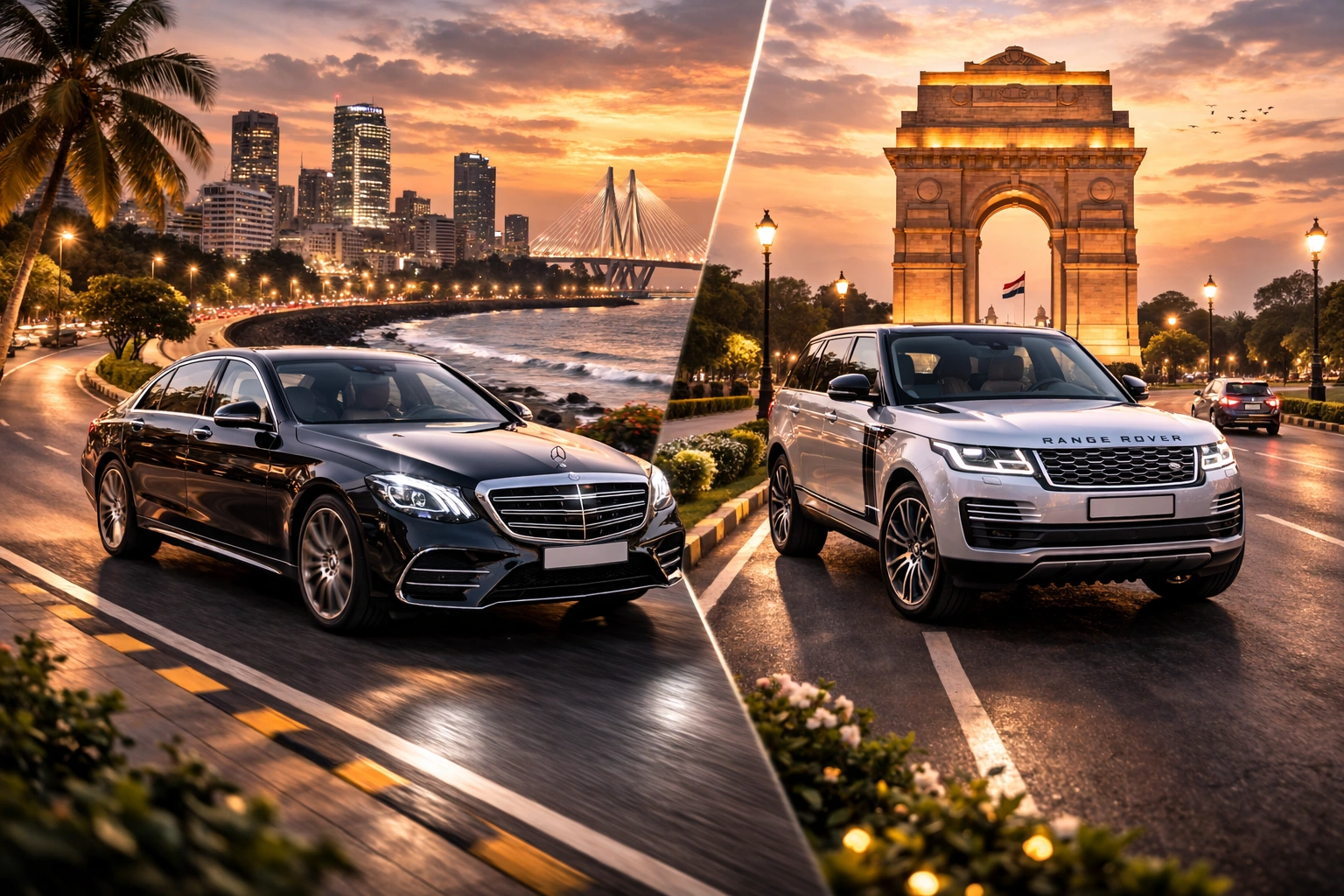
“Is luxury car rental better in Mumbai or Delhi — and how do they actually differ?”
Mumbai and Delhi represent the two largest luxury mobility markets in India, but their operating environments are very different. Travelers often assume that booking a luxury car rental works the same way in both cities, yet traffic patterns, city layout, airport infrastructure, and event culture create major differences in how services are executed.
In Mumbai, dense traffic and compact city zones dominate travel planning. In Delhi NCR, the challenge is the opposite—longer distances, wider roads, and multi-city travel between Delhi, Gurgaon, and Noida. Because of these differences, luxury car rental operations must adapt their scheduling, vehicle selection, and chauffeur coordination accordingly.
Clear answer upfront :
Luxury car rental in Mumbai is primarily defined by congestion management and strict time discipline, while luxury rentals in Delhi NCR require zone-based route planning and larger travel buffers due to the region’s geographic spread. Both markets use similar pricing models, but operational planning, vehicle usage patterns, and chauffeur responsibilities differ significantly.
Understanding these differences helps travelers plan bookings more realistically.
Traffic Patterns and Time Sensitivity
Mumbai’s luxury car rental environment is heavily influenced by traffic density. The city’s narrow corridors and compact geography mean that even relatively short distances between business districts such as Bandra, Lower Parel, and South Mumbai can require extended travel time. Because of this unpredictability, rental services in Mumbai usually operate on time-based packages where booking duration becomes more important than distance travelled.
In Delhi NCR, travel distances are longer but roads are generally wider. However, traffic congestion can still occur on major corridors such as NH-48 and Ring Road. What makes Delhi unique is the geographic spread across multiple urban centres including Central Delhi, Gurgaon, and Noida.
Mumbai concentrates movement within smaller areas, whereas Delhi spreads travel across multiple zones.
Airport Operations in Mumbai and Delhi
Airport transfers represent one of the most important segments of luxury car rentals in both cities, but operational conditions differ significantly.
Mumbai airport operations revolve around Chhatrapati Shivaji Maharaj International Airport, which is located inside the city but surrounded by heavy congestion. Pickup timing and parking coordination must be precise because waiting areas are limited and access roads are busy throughout the day.
Delhi airport transfers operate through Indira Gandhi International Airport. Although access roads are wider, the airport’s large terminal layout and security protocols require more structured pickup coordination. Vehicles often travel longer distances to reach destinations in Gurgaon or Noida.
Mumbai airport transfers demand congestion management, while Delhi transfers require larger geographic planning.
Corporate Travel Differences
Corporate travel patterns vary between the two cities because of their economic structures.
In Mumbai, corporate movement frequently occurs between financial districts, media offices, and luxury hotels located within relatively small city zones. Because of dense traffic, executives often build larger time buffers into their schedules to avoid delays.
Delhi NCR corporate mobility typically involves travel between diplomatic zones, multinational offices, and technology parks across different regions. Chauffeurs must be familiar with multiple NCR sectors and highways connecting them.
Mumbai corporate travel requires patience in congestion, while Delhi corporate travel requires strong route awareness across wider areas.
Wedding and Event Transportation
Luxury wedding transportation also differs between the two cities.
Mumbai weddings usually take place in high-end hotels or banquet venues located within the city. Managing vehicle arrival timing in traffic becomes the main operational challenge. Standby planning and chauffeur coordination are essential to avoid delays during ceremonial entries.
Delhi weddings, particularly in NCR farmhouse venues or large banquet properties, often involve larger guest movements and grand processions. Luxury SUVs are frequently used for groom entries because they provide stronger visual presence and easier access on large event properties.
Event scale and venue layout influence vehicle choices in each city.
Vehicle Preference Trends
Luxury vehicle preferences reflect the practical needs of each city’s environment.
In Mumbai, executive sedans such as the Mercedes-Benz S-Class are widely used for corporate mobility and airport transfers because they navigate congested roads more efficiently while providing strong rear-seat comfort.
In Delhi NCR, luxury sedans remain important for corporate travel, but SUVs such as the Mercedes-Benz GLS or Range Rover are more commonly seen at weddings, political events, and interstate journeys toward Agra or Jaipur.
Delhi sees higher ceremonial SUV demand, while Mumbai relies more on sedan efficiency.
Pricing Structure Comparison
Luxury car rental pricing structures in Mumbai and Delhi are broadly similar, but operational factors influence final billing.
Both cities commonly use time-based packages for city travel and airport transfers. However, Mumbai bookings tend to emphasize strict hourly calculations because traffic delays can extend travel duration significantly.
Delhi NCR rentals often include toll charges for expressways and may involve interstate permits for trips beyond NCR boundaries. Airport parking, waiting beyond complimentary windows, and overtime are generally billed separately in both cities unless specified in the booking agreement.
Clear communication of package inclusions ensures billing transparency.
Chauffeur Skills and Driving Style
Chauffeur discipline is another area where the cities differ.
Mumbai drivers must remain patient and composed while navigating dense traffic lanes and heavy congestion. Smooth braking and careful maneuvering are essential for passenger comfort.
Delhi chauffeurs often operate across larger routes including highways, diplomatic areas, and suburban business districts. They must balance city traffic with faster highway travel while remaining aware of security-sensitive areas.
Driving behaviour adapts to the operational environment of each city.
Common Booking Mistakes
Travelers comparing Mumbai and Delhi luxury rentals sometimes assume that booking rules are identical in both markets. This can lead to unrealistic expectations about travel time or pricing.
Underestimating congestion in Mumbai can cause delays for meetings or airport departures. In Delhi NCR, failing to consider the geographic distance between zones can extend rental duration unexpectedly.
Planning travel buffers according to the city’s mobility patterns helps avoid these issues.
Frequently Asked Questions
Q1. Is luxury car rental more expensive in Mumbai or Delhi?
Ans: Pricing structures are similar, but costs may vary depending on traffic exposure and vehicle type.
Q2. Are luxury SUVs more common in Delhi?
Ans: Yes, SUVs are widely used for events and interstate travel.
Q3. Is traffic more challenging in Mumbai?
Ans: Generally yes, due to dense congestion within compact city areas.
Q4. Does Delhi require more route planning?
Ans: Yes, because travel often spans multiple NCR zones.
Q5. Are airport transfers complicated in both cities?
Ans: Yes, although the operational challenges differ in each location.
Before booking luxury car rentals in either city, travelers should clearly define their travel purpose—whether it involves corporate meetings, airport transfers, weddings, or outstation travel. Travel buffers should be planned differently depending on local conditions.
In Mumbai, congestion awareness is the key factor. In Delhi NCR, geographic distance and route planning become more important.
Conclusion
Luxury car rentals in Mumbai and Delhi operate under very different mobility conditions. Mumbai demands careful congestion management within compact urban corridors, while Delhi requires broader route planning across a large NCR geography.
Vehicle preferences, chauffeur expectations, and scheduling buffers vary accordingly. Understanding these operational differences allows travelers to plan bookings realistically and ensure smoother execution of premium mobility services.
📞 Call us: +91 9167977799 ✉️ Write to us: info@rnk.com