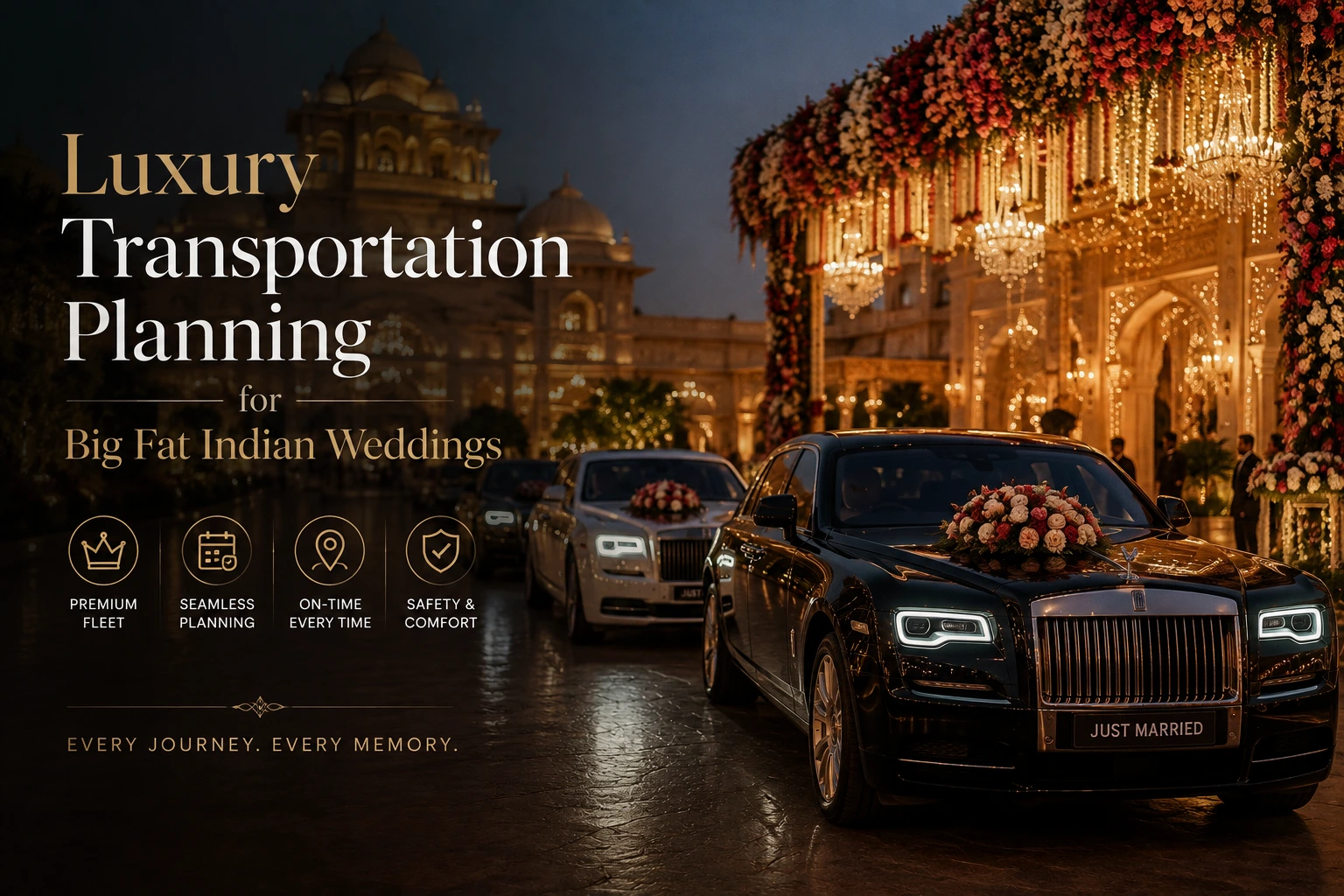
Anyone who has planned a big fat Indian wedding knows that transportation is never just "getting people from A to B." Across three, four, sometimes five days of functions — sangeet, haldi, mehendi, baraat, pheras, reception — vehicles become part of the choreography. The groom's entry car is practically a scene of its own. The bride's getaway car shows up in half the wedding album. And somewhere in the background, someone has to make sure two hundred guests, four sets of grandparents, and a live band all get to the venue on time without anyone standing around waiting for a car.
This guide is built for exactly that planning problem — how to think through luxury wedding transportation as a complete system across the whole event, not just book a nice car for the baraat and hope the rest sorts itself out.
Why Wedding Transportation Needs Its Own Plan
Most wedding planning timelines treat transportation as a line item somewhere near the bottom of the checklist, usually finalized weeks after the venue, decor, and catering are locked in. For a big fat Indian wedding spanning multiple days and multiple venues, that ordering causes more last-minute stress than almost anything else.
The reason is scale. A single-day wedding might need two or three vehicles. A multi-day, multi-venue Indian wedding can realistically need transportation planning across ten or more separate movements — the couple's individual entries, guest transport between functions, out-of-town family logistics, vendor and band transport, and the final wedding-night departure. Each of these has its own timing, its own vehicle requirements, and its own risk of going wrong if it's planned at the last minute.
Treating transportation as its own planning track — with the same lead time as catering or decor — is what actually prevents the chaos everyone associates with Indian wedding logistics.
Mapping Out the Full Wedding Timeline First
Before booking a single car, the most useful thing any couple or planner can do is map every function against a simple grid: date, venue, approximate guest count, and who specifically needs a dedicated vehicle versus who's traveling as part of a group.
This sounds basic, but it's the step most people skip, and it's the one that prevents double-bookings and last-minute scrambling. A typical big fat Indian wedding grid might look like: mehendi and haldi at a family home or smaller venue with mostly local guest movement, sangeet at a banquet hall requiring guest shuttle service, baraat starting from the groom's residence or a hotel with a dedicated entry vehicle, the wedding ceremony itself with separate bride and groom arrival vehicles, and a reception the following evening with its own guest transport and a couple's departure car.
Once this grid exists, the actual vehicle booking conversation becomes far more precise — instead of a vague "we'll need some cars," you're booking against specific, dated requirements.
The Groom's Entry: Choosing the Baraat Vehicle
The baraat entry is one of the most photographed, most remembered moments of the entire wedding, and the vehicle choice carries real symbolic weight alongside the practical logistics.
Traditional choices lean toward vintage cars or an open-top vehicle that allows for the procession, dancing, and dhol that typically accompany a baraat — practicality matters here as much as aesthetics, since the vehicle needs to move slowly through a crowd, sometimes for an extended period, without overheating or requiring the kind of careful handling a hypercar would need. For couples wanting a more contemporary, statement-making entry, a Rolls-Royce or Bentley offers a different kind of impact — less about the procession itself and more about a striking final arrival moment.
Whichever direction fits the couple's vision, the baraat vehicle booking needs to be confirmed well in advance, since it's typically the single most requested vehicle type during Indian wedding season and availability tightens fast for popular dates.
The Bride's Entry and Getaway: Two Different Vehicle Needs
It's worth planning the bride's entry vehicle and her post-wedding getaway car as two separate decisions, since they usually serve very different purposes.
The entry vehicle is about the moment itself — walking or being driven in for the pheras, often coordinated closely with the wedding photographer and videographer for specific shots. This is where a classic luxury sedan or a vintage car with strong visual presence tends to work best, since the vehicle itself becomes part of the ceremony's visual narrative.
The getaway car, by contrast, is about comfort and privacy after a long, emotionally intense day. Couples increasingly choose a completely different, more understated vehicle for this — something comfortable enough for a tired bride and groom to actually relax in, with tinted windows and a quieter presence than the entry vehicle required. Planning these as two distinct bookings, rather than assuming one car will cover both moments well, tends to produce a better result for both.
Guest Transportation: The Part That's Easy to Underplan
Bride and groom vehicles get most of the planning attention, but guest transportation is where big fat Indian weddings most commonly run into real logistical problems — and it's almost always because it was planned too late or too loosely.
For weddings with out-of-town guests, particularly senior family members unfamiliar with the city, dedicated shuttle service between the hotel and venue isn't a luxury add-on — it's close to essential. Running a well-planned shuttle rotation, with clearly communicated pickup times and enough vehicle capacity for peak movement windows like the end of a function, prevents the common scenario of fifty guests trying to leave a venue at once with only a handful of cars available.
For weddings with distinct multi-generational needs, it's worth planning at least one or two more accessible, comfortable vehicles specifically for elderly guests — separate from the main shuttle rotation, since older guests often need more flexible timing and easier vehicle access than a shared shuttle schedule allows.
Getting an accurate guest count and a realistic sense of when large groups will need to move simultaneously is genuinely the single most useful piece of information to hand a transportation provider early — it's what allows them to plan fleet size and timing properly instead of guessing.
Building the Right Fleet Mix for a Multi-Day Wedding
A well-planned wedding fleet is rarely all one type of vehicle — it's a deliberate mix matched to each specific need across the event.
For the couple's key moments — baraat entry, ceremony arrival, getaway car — the focus is on presence and photography value, which usually points toward luxury sedans, vintage cars, or a standout model like a Rolls-Royce for a single statement moment. For guest shuttle service, the priority shifts entirely to capacity and reliability, which usually means a mix of premium MPVs and larger vehicles like the Mercedes V-Class or similar seven-plus-seat options that can run consistent rotations without guests waiting long between pickups. For vendor and equipment transport — photography teams, decor items, sometimes a live band's instruments — a separate, more functional vehicle keeps this logistics layer from competing with guest-facing transportation for the same cars.
Planning this mix properly, with enough lead time to actually secure preferred models for the key moments, is what separates wedding transportation that runs smoothly from wedding transportation that becomes a source of last-minute stress.
Booking Timelines: When to Lock Everything In
Wedding season in India creates genuine scarcity for the most in-demand vehicles, and the couples who get the exact car they want are almost always the ones who booked early.
As a general planning guideline, the standout statement vehicles — a specific vintage car model, a Rolls-Royce or Bentley for the baraat or entry — are worth locking in as early as six to eight months out for peak wedding season dates, since these are also the most requested models for every other wedding happening in the same window. Guest shuttle fleets and more standard luxury sedans have somewhat more flexibility but are still worth confirming two to three months out to guarantee availability and lock in pricing before season demand pushes rates up.
The multi-day, multi-venue nature of big fat Indian weddings also means it's worth confirming the full fleet plan — not just individual vehicles — with a single provider where possible, since coordinating timing and vehicle handoffs across days is significantly easier when one team is managing the whole plan rather than juggling multiple separate vendors.
Questions to Ask a Wedding Transportation Provider
A few specific questions early in the planning process will tell you quickly whether a provider can genuinely handle a full multi-day wedding fleet, or is better suited to a single-vehicle booking.
Ask whether they can commit to specific vehicles for specific dates this far in advance, and what the process looks like if a preferred vehicle becomes unavailable closer to the date. Ask how they handle guest shuttle logistics specifically — how they calculate the right number of vehicles for expected guest movement, and how pickup timing is communicated on the day. Ask whether they've handled weddings of a similar scale and venue type before. And ask directly what the full fleet plan would look like across all your dates and functions, rather than booking function by function.
A provider that can answer these clearly, and offers to build out a complete fleet plan against your wedding timeline rather than just quoting individual cars, is generally the stronger long-term choice for a big, multi-day celebration.
Frequently Asked Questions
How far in advance should we book wedding transportation in India? Statement vehicles like vintage cars or a Rolls-Royce for the baraat should ideally be booked six to eight months ahead for peak wedding season. Guest shuttle fleets and standard luxury sedans have more flexibility but are best confirmed two to three months out.
Should the bride's entry car and getaway car be the same vehicle? Not necessarily — many couples choose a visually striking vehicle for the ceremonial entry and a more comfortable, understated car for the post-wedding getaway, since the two moments serve different purposes.
How many vehicles do we actually need for guest transportation? This depends heavily on guest count and how many people are likely to move at the same time, particularly at the end of functions. Sharing an accurate guest list and function schedule with your transportation provider early allows them to calculate realistic shuttle capacity rather than guessing.
Can one provider handle transportation across all wedding functions? Yes, and it's generally the better approach for multi-day weddings — coordinating timing and vehicle handoffs across several days and venues is considerably easier with a single provider managing the full plan.
What's the biggest transportation mistake couples make when planning a big Indian wedding? Underestimating guest shuttle needs and planning transportation too late, after the venue and decor are already finalized — this is what most commonly leads to guests waiting for cars or last-minute scrambling for extra vehicles.
The Bottom Line
Luxury transportation for a big fat Indian wedding works best when it's planned as a complete system from the start — mapped against the full event timeline, with the right vehicle mix for each specific moment, and locked in early enough to guarantee the cars that matter most. Done well, it becomes part of what makes the wedding feel effortless. Done late, it becomes the one thing everyone remembers going wrong.
Planning a wedding and need to map out your full transportation timeline? Get in touch with our team to build a complete fleet plan across all your functions, or explore the full RNK fleet to start shortlisting your entry and getaway vehicles.