
Karjat has become one of the go-to escapes for Mumbai-based companies planning offsites and retreats — close enough for a comfortable two-to-three-hour drive, but far enough to feel like a genuine break from the city. That proximity is exactly what makes transportation planning for these retreats deceptively easy to underplan. It's not a long-haul journey requiring flights, so companies sometimes treat it with less rigor than a multi-city event — and that's usually where things go wrong, with staggered pickups, mismatched vehicle capacity, or a return leg nobody planned for after a long, tiring two days.
This guide walks through how to plan corporate retreat transportation between Mumbai and Karjat properly — from picking the right vehicle mix to handling staggered team arrivals and the return journey.
Why Mumbai-to-Karjat Retreats Need Their Own Transportation Plan
A retreat this close to the city creates a specific planning trap: because it doesn't feel like "real" outstation travel, transportation sometimes gets treated as an afterthought rather than something worth mapping out properly.
In practice, a Karjat retreat still involves everything a longer outstation trip does — multiple team members traveling together or separately, resort or venue access that may involve unpaved or narrow roads, and a return journey that needs just as much planning as the outbound leg, especially if it happens after a late team dinner or long final session. Our broader guide on chauffeur-driven outstation trips and their benefits and our outstation travel page both cover the general planning principles that apply here, scaled down to a shorter, more frequent retreat format.
Mapping Team Travel Patterns Before Booking Vehicles

The first real planning step is understanding exactly how your team will be traveling to Karjat — not everyone leaves from the same office at the same time, and retreat transportation plans that assume otherwise tend to run into trouble.
Some employees may travel directly from home, others from the office, and senior leadership sometimes has a separate, more flexible schedule than the broader team. Mapping this out — who's traveling from where, and roughly when — before booking vehicles prevents the common scenario of half the team waiting at a pickup point because the vehicle plan assumed a single departure location.
Choosing the Right Vehicle Mix for a Mumbai-Karjat Retreat
A well-planned retreat fleet is almost always a mix, matched to team size, seniority tiers, and the specific comfort needs of a longer road journey rather than a short city transfer.
For senior leadership or smaller executive groups, a comfortable sedan or SUV like the Mercedes E-Class or Toyota Fortuner works well for the roughly two-to-three-hour drive. For larger teams traveling together, premium MPVs like the Innova Crysta or Hycross offer a good balance of comfort and group cohesion for the journey itself. For very large retreats or company-wide offsites, larger-capacity options like the Toyota Coaster or Urbania reduce the total number of vehicles needed while keeping the team together for the drive. Our guide on SUV versus sedan luxury rentals in India is a useful reference for choosing between vehicle classes for this kind of trip specifically.
Road Conditions and Access: What to Confirm About the Venue
Karjat's resort and retreat venues vary considerably in road access — some sit right off the main highway, while others involve a stretch of narrower, less maintained road toward the final approach.
It's worth confirming venue access details with your transportation provider ahead of time, particularly for larger vehicles like coaches, which may not be able to navigate the final stretch to certain properties. Our family road trips in India with premium vans guide touches on similar road-condition planning considerations that apply just as well to a corporate retreat context.
Scheduling the Outbound and Return Journeys
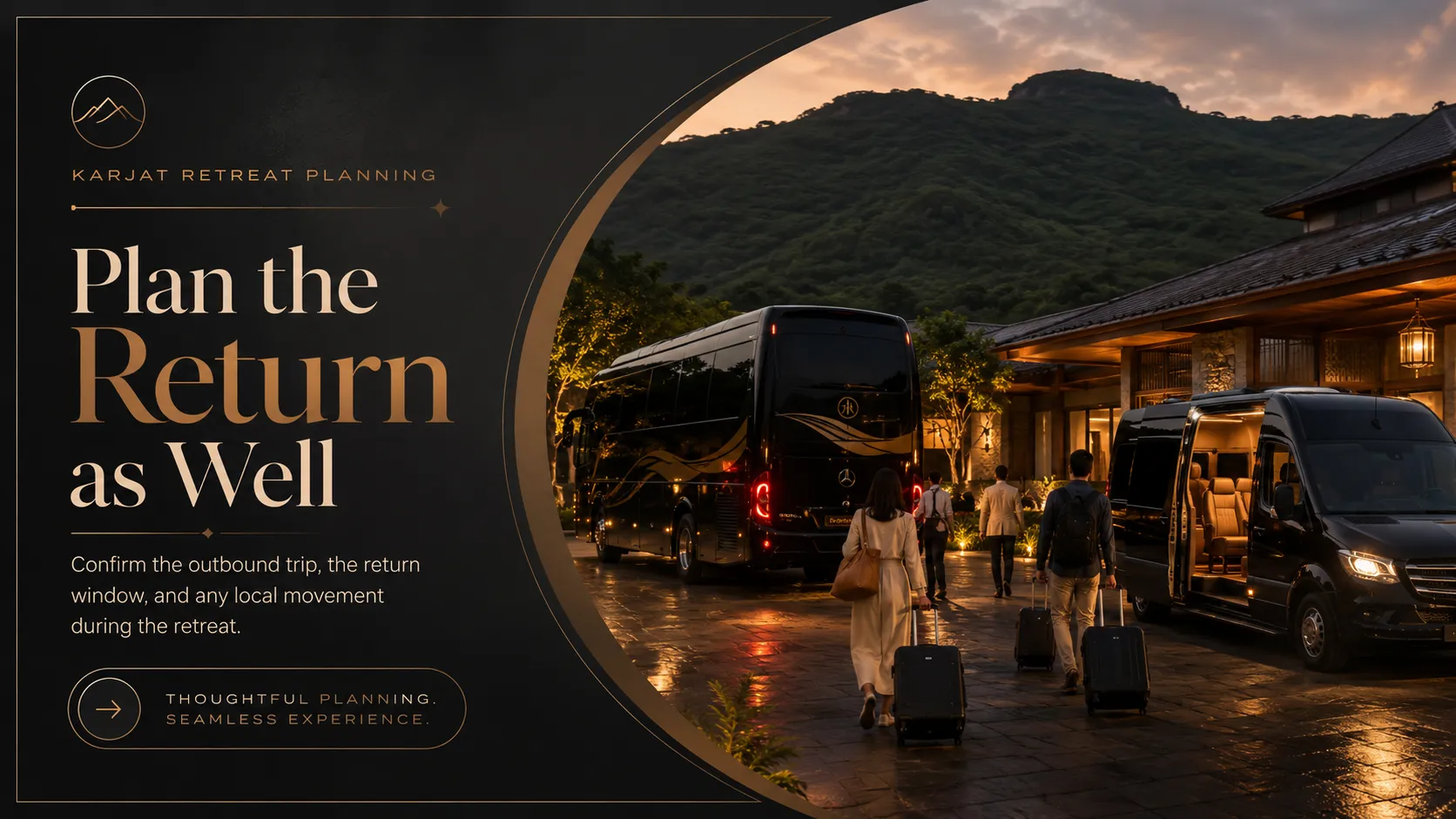
Retreat transportation planning often focuses heavily on the outbound leg and treats the return as an afterthought — which is exactly backwards, since the return journey usually happens when everyone is more tired and schedules are more likely to have shifted from the original plan.
Building in a confirmed return time — checked and reconfirmed on the final day of the retreat rather than assumed from the original itinerary — prevents the common scenario of a team standing around waiting for cars after a long final session or closing dinner. If the retreat includes any evening activities extending later than planned, it's worth having the transportation provider on standby for a flexible return window rather than a single fixed pickup time.
Multi-Day Retreat Logistics: Planning Beyond a Single Round Trip
For retreats spanning two or three days, transportation needs often extend beyond the initial arrival and final departure — local movement around Karjat itself, whether for activities, off-site meals, or excursions, needs its own planning layer.
This is where having a single coordinated transportation provider for the full retreat — rather than a one-off booking for just the Mumbai-to-Karjat leg — makes a meaningful difference, since the same vehicles and drivers can handle both the outstation journey and any local movement during the retreat itself.
Staggered Arrivals: Planning for Teams That Can't Travel Together
Not every retreat has the luxury of the whole team traveling in one coordinated group — client meetings, differing work schedules, or senior leadership joining a day later are all common reasons for staggered arrivals.
Planning for this upfront, with a clear list of who's arriving when and from where, prevents last-minute scrambling to arrange an additional vehicle for someone who couldn't make the main departure window. This is essentially the same planning discipline used for corporate event transportation more broadly, scaled to the retreat's specific, often smaller group size.
Budgeting for Mumbai-Karjat Corporate Retreat Transportation
Cost planning for this route is generally more straightforward than longer outstation trips, but it's still worth getting itemized quotes rather than a single bundled number, especially for multi-day retreats with local movement included.
Our luxury car rental cost in India explained guide breaks down the general cost factors — vehicle class, duration, driver allowances — that apply to this kind of shorter outstation trip as much as to longer journeys.
Why More Companies Are Formalizing Retreat Transportation Planning
As corporate retreats and offsites have become a more regular part of company culture and team-building strategy, the transportation planning behind them has started to get the same structured attention as any other recurring corporate travel need.
Our monthly corporate car rental plans guide covers how companies running frequent retreats or offsites benefit from a standing arrangement rather than booking fresh each time, and our broader piece on why MNCs prefer premium chauffeur services covers the reliability and consistency reasoning behind this shift.
Questions to Ask a Provider About Mumbai-Karjat Retreat Transportation
A few specific questions will tell you quickly whether a provider can handle your retreat's full transportation needs, not just the outbound drive.
Ask whether they're familiar with specific resort or venue access roads in the Karjat area. Ask how they handle staggered team departures and arrivals. Ask whether the same vehicles can be used for local movement during the retreat itself, not just the Mumbai-Karjat legs. And ask how flexible their return-journey timing is if the retreat schedule shifts on the final day.
Frequently Asked Questions
How long does the drive from Mumbai to Karjat typically take? Roughly two to three hours depending on traffic and the specific route, making it a manageable same-day or short overnight retreat option for Mumbai-based companies.
What vehicle is best for a team retreat to Karjat? It depends on group size — sedans or SUVs suit smaller executive groups, while premium MPVs or larger coaches work better for bigger teams traveling together.
Should the return journey be planned differently from the outbound trip? Yes — return journeys often happen later than planned and when the team is more tired, so it's worth confirming a flexible return window rather than assuming the original schedule will hold exactly.
Can the same transportation provider handle local movement during the retreat, not just the drive to and from Karjat? Yes, and it's generally the better approach — using one coordinated provider for both the outstation journey and any local activity transfers keeps logistics simpler across a multi-day retreat.
Is it worth setting up a standing arrangement for recurring company retreats? For companies running regular offsites, a standing arrangement with a familiar provider generally improves consistency and can simplify planning compared to booking fresh for each retreat.
The Bottom Line
Corporate retreat transportation between Mumbai and Karjat is easy to underplan precisely because the distance feels short — but it still deserves the same careful mapping of team travel patterns, vehicle choice, and return-journey planning as any other corporate trip. Get that right, and transportation becomes one less thing your team has to think about before they can actually switch off and enjoy the retreat.
Planning a Mumbai-to-Karjat retreat and need to map out transportation for your team? Get in touch with our team to plan your full retreat fleet, or explore the full RNK fleet to see vehicles suited to your group size.