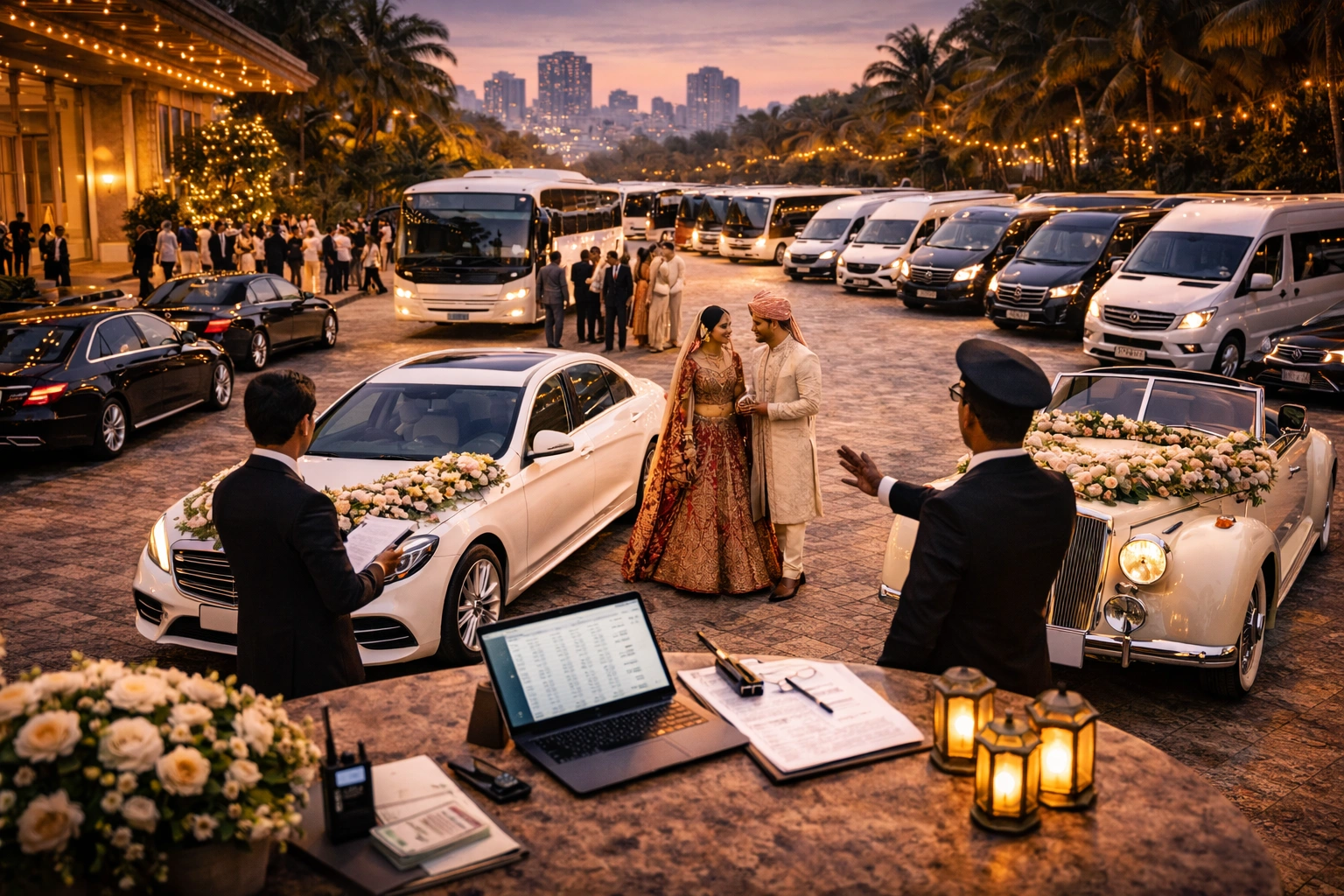
“We Have 200–400 Guests. Exactly How Many Cars Should We Book for Our Wedding?”
In Indian weddings, transportation is often treated as a last-minute arrangement rather than a structured logistical decision. Most families invest heavily in venues, décor, and hospitality, assuming that guest movement will naturally fall into place.
In reality, transportation is one of the few elements that directly affects timing, guest comfort, and overall event flow. Poor planning can lead to delayed ceremonies, crowded entrances, and unnecessary stress for both families and guests.
The real challenge is not the number of vehicles—but how intelligently they are planned. Wedding transportation in India is a coordination exercise, not just a booking task. Choosing the right wedding transport services plays a crucial role.
Clear Answer: The number of cars required for an Indian wedding depends on guest segmentation, venue logistics, timing overlap, and service expectations. For a 200–300 guest wedding, a well-structured plan typically includes one premium entry car, 5–8 family vehicles, 2–4 VIP cars, and buses or vans for bulk guest movement.
Step 1: Stop Calculating Based Only on Guest Count
One of the most common mistakes families make is directly linking vehicle count to total guests. This approach almost always results in inefficiency.
Transportation should instead be planned based on movement patterns, not headcount. Different groups of guests move at different times and require different levels of service.
A structured plan begins with identifying categories—ceremonial vehicles, family transport, VIP movement, and general guest flow. You can also refer to this wedding guest transportation planning guide.
Once these segments are defined, vehicle requirements become far more predictable and controlled.
Step 2: Bride and Groom Entry Vehicles
The entry vehicle is not just a mode of transport—it is a visual and ceremonial element of the wedding. It plays a key role in photography, videography, and overall presentation.
Luxury sedans, vintage cars, or premium SUVs are commonly selected depending on the wedding theme. The focus here is on elegance and timing rather than utility. Premium cars like Rolls Royce are often preferred for grand entries.
If the bride and groom arrive separately or from different locations, two vehicles may be required. Otherwise, a single premium car is sufficient.
These vehicles are typically used for short durations and should always be planned independently from the rest of the fleet.
Step 3: Immediate Family Transport Planning
Close family members require consistent, comfortable, and reliable transportation throughout the event. Their movement is frequent and often time-sensitive.
For a core group of 25–40 people, 5–7 vehicles usually provide a good balance between flexibility and efficiency. These can include a mix of luxury sedans and SUVs like Mercedes E-Class and Mercedes GLS.
Some families prefer grouping relatives in larger vehicles like MPVs or luxury vans to reduce coordination complexity.
At this level,timing and coordination matter far more than vehicle type or brand.
Step 4: VIP and Priority Guest Movement
VIP guests represent a category that requires separate attention. This may include senior family members, business associates, or elderly guests.
Providing dedicated vehicles ensures punctual arrivals and avoids dependency on shared transport systems.
Typically, 2–4 premium vehicles are sufficient for this category, depending on the guest profile. Many planners rely on luxury chauffeur-driven services.
Well-managed VIP transport significantly improves the overall perception of the event.
Step 5: Bulk Guest Transportation Strategy
For larger guest groups, using individual cars is neither efficient nor practical. It increases congestion and complicates coordination.
Shuttle-based systems using buses or large vans are far more effective. They allow controlled movement and reduce the total number of vehicles required.
For 200–300 guests, 4–6 buses or a combination of buses and vans usually works well, especially for hotel-to-venue transfers using options like Volvo buses.
A structured shuttle system ensures smooth arrivals without overcrowding entry points.
Step 6: Multi-Venue Weddings Increase Complexity
Modern Indian weddings often involve multiple venues—hotels, ceremony locations, and reception spaces. Each transition introduces a new layer of transport planning.
Vehicle requirements typically increase by 20–30% in such scenarios due to overlapping schedules and multiple guest movements.
Without proper coordination, these transitions can lead to delays and confusion. You can explore this destination wedding car rental guide.
Adding buffer vehicles and planning staggered movements helps maintain control over the timeline.
Step 7: Airport and Railway Transfers Require Separate Planning
Outstation guests are a major part of most weddings, especially in metro cities and destination events.
Airport and railway transfers should always be handled independently from event-day transport. Mixing the two often leads to scheduling conflicts.
Dedicated vehicles for arrivals and departures ensure smoother coordination and reduce pressure on the main fleet. Using airport and railway transfer services helps streamline this.
This separation is essential for maintaining operational clarity.
Common Mistakes That Disrupt Wedding Transport
The biggest issue in wedding transport is not shortage—but mismanagement.
Planning based only on guest count leads to inefficiency. Ignoring traffic conditions can disrupt schedules.
Lack of a central coordinator often results in confusion between drivers and guests.
Many families also forget to plan return transport, which creates unnecessary chaos at the end of the event. Avoid mistakes mentioned in this wedding car booking mistakes guide.
Avoiding these mistakes significantly improves execution.
Practical Tips for Smooth Wedding Transport
Start planning transportation at least 3–4 weeks in advance to ensure availability and clarity.
Work with experienced providers who understand wedding logistics and timing sensitivity.
Use a balanced fleet instead of relying only on cars. This improves efficiency.
Assign a single coordinator to manage vehicle movement during the event. For city-level execution, you can explore wedding transport in Mumbai.
Clear planning always leads to a smoother and more professional experience.
Frequently Asked Questions
How many cars are needed for a 200-guest wedding? Ans: Typically 10–15 vehicles, depending on guest segmentation and venue logistics.
Is one luxury car enough for bride and groom entry? Ans: Yes, if both entries are coordinated at the same venue and time.
Are buses better than multiple cars? Ans: Yes, buses are significantly more efficient for managing large guest groups.
Should VIP guests have separate vehicles? Ans: Yes, dedicated transport ensures comfort, punctuality, and better coordination.
When should wedding transport planning begin? Ans: Ideally 3–4 weeks in advance for proper execution.
Conclusion
The number of cars required for an Indian wedding is not a fixed number—it is the result of structured planning and coordination.
When transportation is approached strategically, vehicle requirements become clear, efficient, and cost-effective. Guests arrive comfortably, events stay on schedule, and the overall experience feels organised.
In large weddings, transportation is not just support—it is a key operational layer that defines how smoothly the entire celebration unfolds.
📞 Call us: +91 9167977799 ✉️ Write to us: info@rnk.com