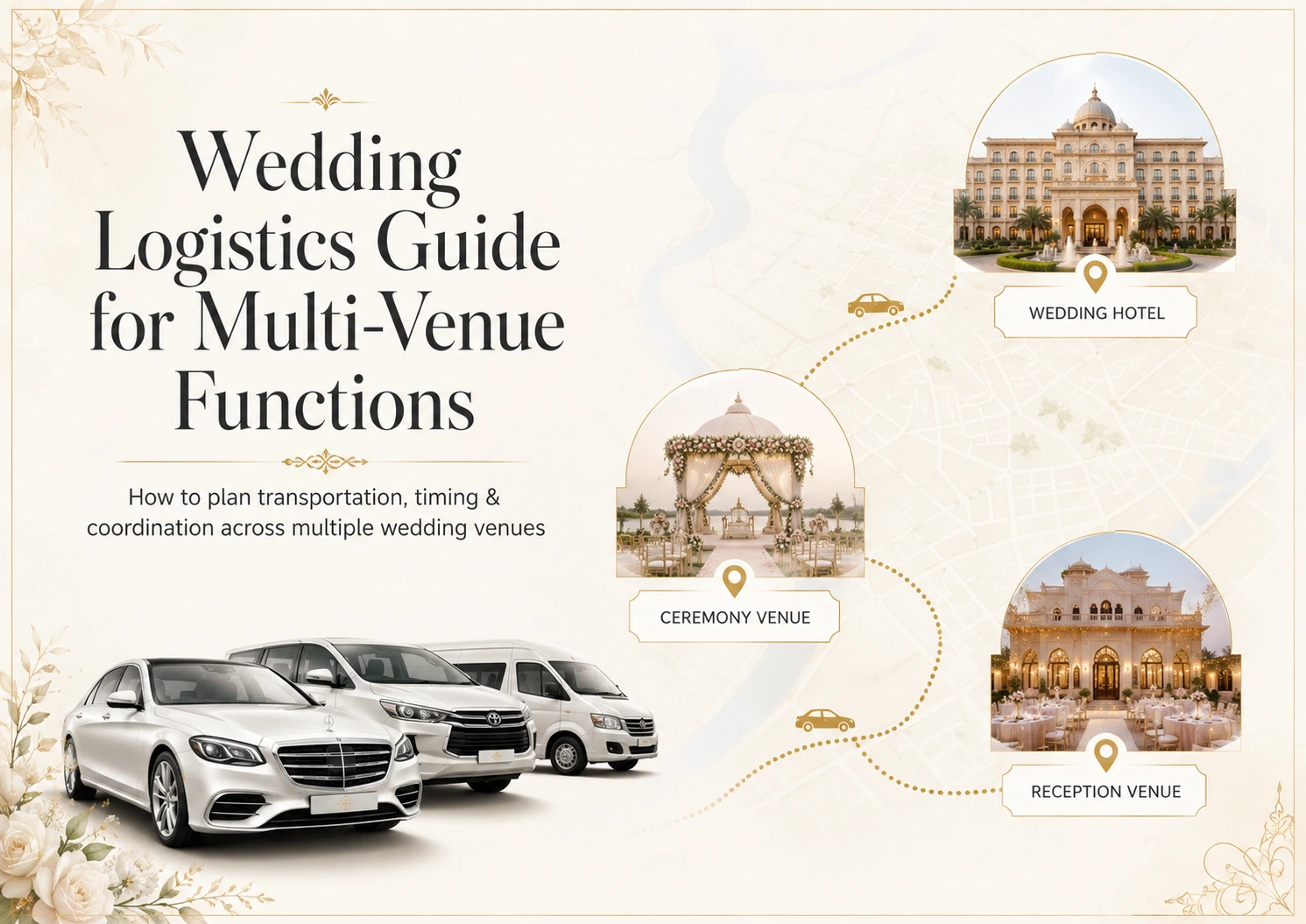
Big fat Indian weddings rarely happen at one venue. A typical celebration might have the haldi and mehendi at a family home or smaller property, the sangeet at a banquet hall across town, the baraat starting from a hotel, the ceremony at a third venue entirely, and the reception somewhere else again the following evening. Each of these venues has its own address, its own access road, its own timing — and somewhere in between all of it, guests, family, and the couple all need to actually get from one place to the next without anyone standing around waiting for a car.
This guide walks through how to plan wedding logistics specifically for multi-venue functions — the sequencing, timing, and coordination that keeps a spread-out wedding running smoothly instead of becoming a source of last-minute stress.
Why Multi-Venue Weddings Need a Different Kind of Planning
A single-venue wedding is relatively forgiving — guests arrive once, stay put, and leave once. A multi-venue wedding multiplies every transportation decision by the number of venues and functions involved, and small timing gaps at one venue tend to compound by the time they reach the next.
The core challenge isn't any single transfer — it's the cumulative effect of several transfers happening across multiple days, often with overlapping guest groups moving at different times. Planning this properly means thinking about the wedding as a connected sequence of movements, not a series of separate, unrelated bookings. Our luxury transportation planning guide for big fat Indian weddings covers the broader version of this same problem, and this guide goes deeper specifically into the multi-venue coordination piece.
Step One: Build a Master Venue-and-Timing Grid
Before booking a single vehicle, the most useful thing any couple or planner can do is build a simple grid mapping every function against its venue, date, start time, and expected guest count.
This should include not just the "main" events but every movement in between — hotel to haldi venue, haldi venue back to hotel, hotel to sangeet venue, and so on. It sounds tedious, but it's what turns a vague sense of "we have a few venues" into an actual, plannable transportation schedule. Once this grid exists, it becomes far easier to spot potential conflicts — like two functions scheduled close together at venues that are a significant drive apart, which might require rethinking the timeline itself before transportation can even solve the problem. Our wedding car rental checklist includes a version of this planning step as part of a broader pre-booking checklist.
Step Two: Separate Statement Vehicles From Shuttle Logistics
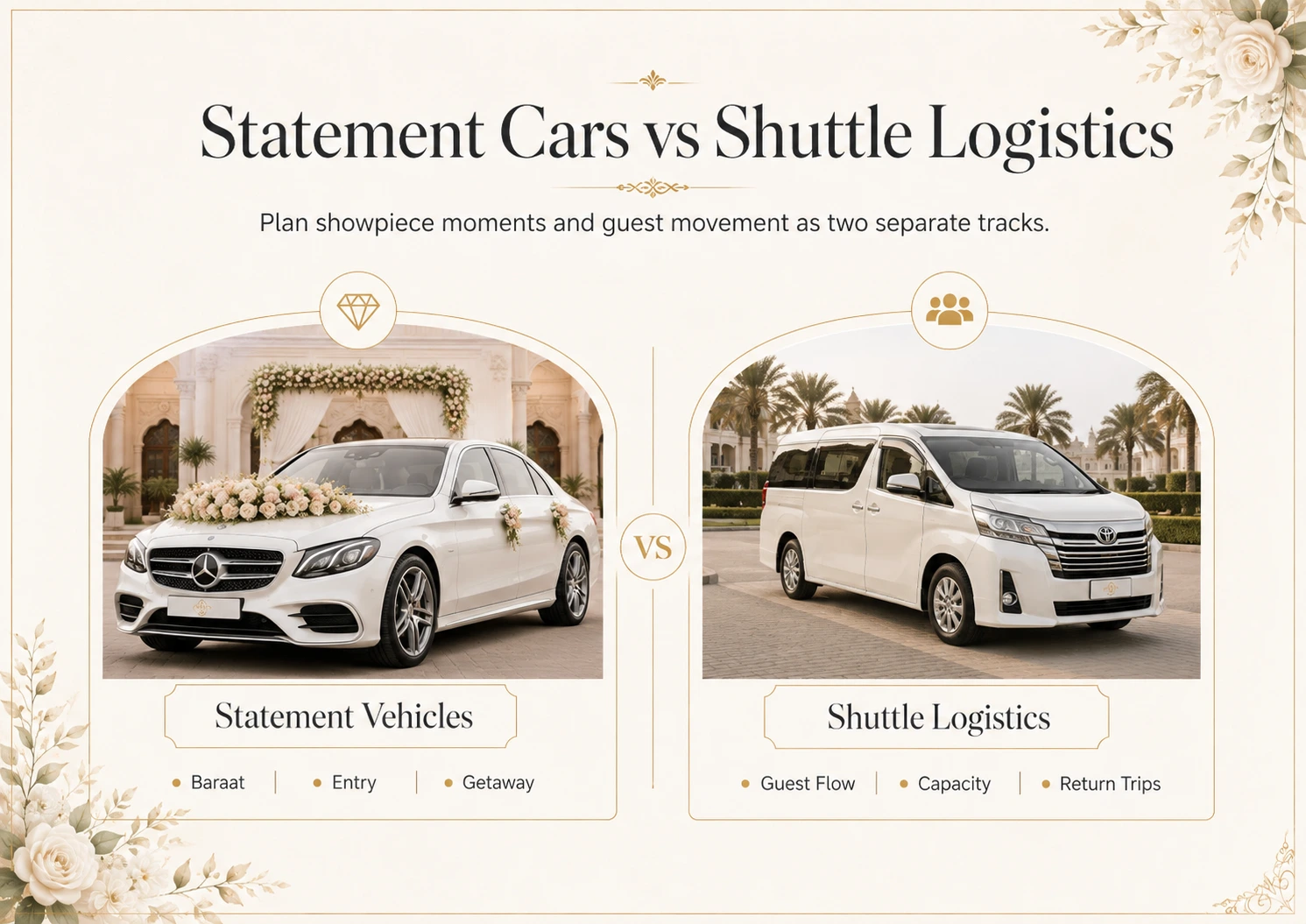
Multi-venue weddings involve two very different categories of transportation, and treating them as one combined problem tends to create confusion.
Statement vehicles — the baraat car, the couple's entry and getaway vehicles — need to be planned around specific, non-negotiable moments at specific venues, usually requiring their own dedicated timing separate from the broader guest movement. Guest shuttle logistics, by contrast, need to be planned around volume and flow — getting the largest possible number of people between venues reliably, without the same emphasis on a single dramatic moment. Our guides to the best luxury cars for baraat entry and wedding guest transportation planning each go deeper into these two distinct planning tracks.
Keeping these separate in your planning grid — rather than trying to solve them with the same fleet or timing logic — makes both easier to get right.
Step Three: Plan for Venue-to-Venue Travel Time Realistically
One of the most common multi-venue planning mistakes is underestimating travel time between venues, especially in cities with unpredictable traffic or venues located in older, less accessible parts of a city.
It's worth building in genuine buffer time between functions — not just the direct driving time between two addresses, but realistic time for guests to actually load into vehicles, travel, and settle in before the next function begins. This matters even more for destination weddings, where the transportation team may be less familiar with local road conditions than a provider working in their home city. Our wedding and event cars in Jaipur, Rajasthan guide and our destination wedding car rental guide both cover this specific challenge in more depth.
Step Four: Coordinate Peak Movement Windows
The single most common failure point in multi-venue wedding logistics isn't the outbound journey to a venue — it's the return trip, when a large concentration of guests all want to leave at roughly the same time.
This is especially true at the end of a function like the sangeet or reception, where guest movement happens in a short, concentrated burst rather than spread evenly over an hour. Planning extra vehicle capacity specifically for these peak return windows — rather than sizing the fleet around the more gradual arrival pattern — is what prevents guests standing around waiting after a long evening. Our wedding guest transportation planning guide covers exactly how to calculate this kind of peak-capacity planning.
Step Five: Assign a Single Point of Coordination
Multi-venue weddings involve enough moving pieces that informal, ad hoc coordination — family members calling drivers directly, guests trying to arrange their own transport between venues — tends to break down quickly.
Assigning a single point of contact between the wedding planning team, the venues, and the transportation provider removes a significant amount of on-the-ground confusion. This person (or team) should have the full venue-and-timing grid, direct contact with drivers or dispatch, and the authority to adjust timing in real time if a function runs long or a venue transfer takes longer than expected. Our full wedding and event transport service page covers how RNK structures this kind of coordinated, single-provider approach across a multi-day, multi-venue wedding.
Step Six: Plan Separately for VIP, Elderly, and Out-of-Town Guests
Not every guest has the same transportation needs, and a multi-venue wedding is exactly the kind of event where this distinction matters most.
Elderly guests or close family often need more comfortable, private transfers with more flexible timing than a shared shuttle rotation allows. Out-of-town guests unfamiliar with the city need clear, simple instructions about where and when to be picked up at each venue — assuming they can navigate an unfamiliar multi-venue schedule on their own is a common source of confusion. Planning a distinct, slightly more flexible transportation track for these groups, separate from the main guest shuttle, tends to prevent the most common on-the-ground complaints at multi-venue events.
Handling Vendor and Equipment Transport Separately
Guests and family aren't the only ones moving between venues — photography and videography teams, decor and event staff, and sometimes a live band or DJ setup all need to move as well, often with equipment that requires its own dedicated vehicle.
Keeping vendor transport as a distinct category, with its own timing separate from guest-facing shuttles, prevents this logistics layer from competing with guest transportation for the same vehicles at the same time — a common source of unnecessary tension when everything is planned as one undifferentiated fleet.
Building the Right Fleet Mix for a Multi-Venue Wedding
A well-planned multi-venue fleet is almost always a deliberate mix rather than one vehicle type used throughout.
For statement moments, the focus is on presence and photography value at specific venues and specific times. For guest shuttle logistics, the priority shifts to capacity and reliability across multiple venue-to-venue transfers — larger vehicles like the Mercedes V-Class or premium MPVs tend to work well here, since they reduce the total number of vehicles and drivers needed to run consistent rotations. You can browse the full RNK fleet to see the range of options across both categories.
Questions to Ask a Provider About Multi-Venue Coordination
A handful of specific questions will tell you quickly whether a transportation provider can genuinely handle a multi-venue wedding, rather than treating each function as a separate, disconnected booking.
Ask whether they can work from a single master schedule covering all your venues and functions, rather than booking function by function. Ask how they handle peak return windows at the end of each event. Ask whether they've coordinated multi-venue weddings in your specific city or destination before. And ask whether they provide a single point of contact for the full event, rather than different coordinators for different days. Our guide on common mistakes to avoid while renting luxury cars covers a few additional questions worth asking any provider before committing to a full multi-day plan.
Frequently Asked Questions
How far in advance should multi-venue wedding transportation be planned? Ideally as soon as all venues and function dates are confirmed — building the master venue-and-timing grid early gives both the couple and the transportation provider enough lead time to plan realistically.
What's the biggest logistics mistake couples make with multi-venue weddings? Underestimating travel time and buffer between venues, and underestimating the peak return-trip volume at the end of each function — both are far more common failure points than the outbound journey to a venue.
Should each venue have its own separate transportation booking? No — it's generally far more reliable to coordinate all venues and functions through a single provider working from one master schedule, rather than juggling separate bookings for each day or venue.
Do elderly or out-of-town guests need separate transportation planning? Yes, generally — planning a more flexible, comfortable transport track for these guests separately from the main shuttle rotation tends to prevent the most common on-the-ground issues at multi-venue events.
How is vendor transport different from guest transport? Vendor and equipment transport — photography teams, decor staff, live bands — is best planned as its own category with dedicated timing, so it doesn't compete with guest-facing shuttles for the same vehicles.
The Bottom Line
Multi-venue wedding logistics come down to treating transportation as a connected system rather than a series of separate bookings — a master timing grid, clear separation between statement and shuttle vehicles, realistic travel buffers, and a single point of coordination across the whole event. Planned this way, moving between venues becomes a background detail guests barely notice, rather than the thing that defines how organized the wedding felt.
Planning a multi-venue wedding and need to map out the full logistics? Get in touch with our team to build a coordinated fleet plan across all your venues, or explore the full RNK fleet to see what's available for your dates.