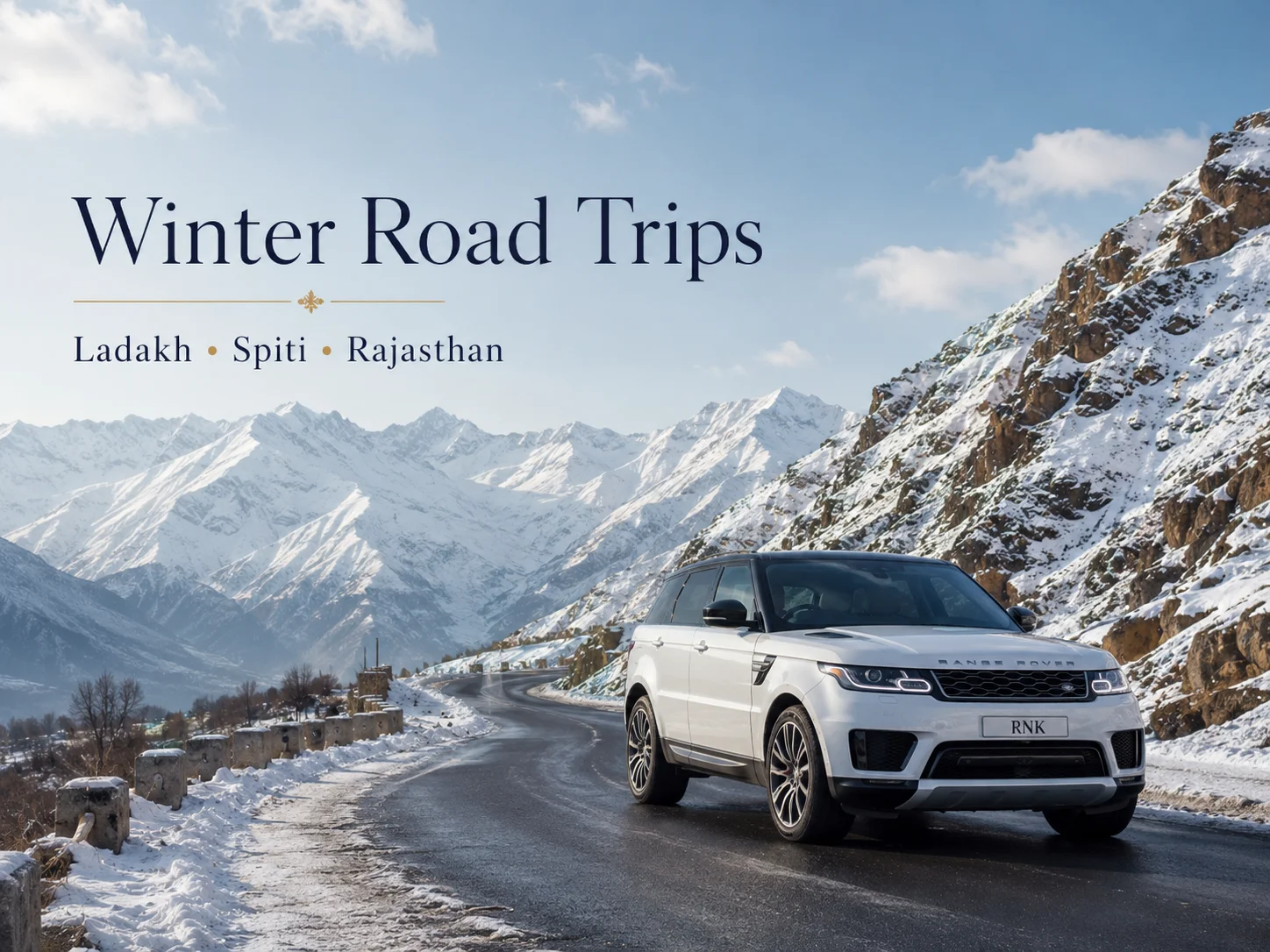
Winter Road Trips in Luxury Cars: Ladakh, Spiti & Rajasthan Snow Routes
Winter changes the meaning of a road trip in India.
The same mountains that are busy with motorcycles and tourist vehicles in summer can become silent under snow. High-altitude lakes freeze, valleys turn white, temperatures fall far below zero and familiar roads become considerably more demanding. At the other end of the spectrum, Rajasthan enters one of its most comfortable driving seasons, with cooler days making long heritage and desert journeys far more enjoyable than they are during peak summer.
That contrast makes winter one of the most interesting seasons for luxury road travel.
But it is also one of the easiest seasons to plan incorrectly.
A winter road trip to Ladakh or Spiti cannot be treated like a normal Delhi-to-Jaipur highway holiday. Snowfall can temporarily close mountain roads. Black ice can appear even when the road looks clear. Accommodation and fuel availability may become limited in remote regions. Temperatures can fall dramatically after sunset, and high altitude adds another layer of planning that has nothing to do with how capable or expensive the vehicle is.
There is also an important distinction to make about Rajasthan.
Rajasthan should be considered a premium winter road-trip destination, not a dependable snow-road destination. Its attraction during December, January and February is the cooler weather, desert scenery, heritage cities, forts and long open-road itineraries rather than regular snowfall.
The short answer: travellers looking for the best luxury winter road trips in India can consider Ladakh for specialised high-altitude winter travel, Spiti for experienced and carefully planned snow journeys, and Rajasthan for a far easier luxury winter driving circuit through heritage and desert landscapes. For Ladakh and Spiti, the road that is theoretically available is not necessarily the road that should be driven on a particular day. Current government advisories, snow clearance, altitude, weather and local driver guidance must determine the final route.
For travellers who prefer professional road-trip coordination rather than managing multiple vehicles and transfers independently, RNK's luxury travel services can be incorporated into multi-day chauffeur-driven itineraries.
Why Winter Road Trips Need a Completely Different Planning Approach
Summer road-trip planning usually revolves around distance, hotels and sightseeing.
Winter mountain travel adds several additional variables.
You need to know whether the route is actually open.
You need to know whether it has reopened only recently after snowfall.
You need to know whether the assigned chauffeur has experience with snow and sub-zero mountain conditions.
You need accommodation that will genuinely operate during the dates of travel rather than simply appearing online.
You need a vehicle selected around terrain and temperature rather than status.
And you need enough time in the itinerary to remain stationary if the weather changes.
This is the fundamental difference between an ordinary road holiday and a winter Himalayan journey.
A luxury winter trip should never depend on everything going exactly according to schedule.
It should be designed so that if a road closes for a day, the entire holiday does not collapse.
RNK's guide to the best routes for winter road trips in North India provides a broader starting point for travellers comparing different cold-season destinations.
Ladakh in Winter: Beautiful, Extreme and Frequently Misunderstood
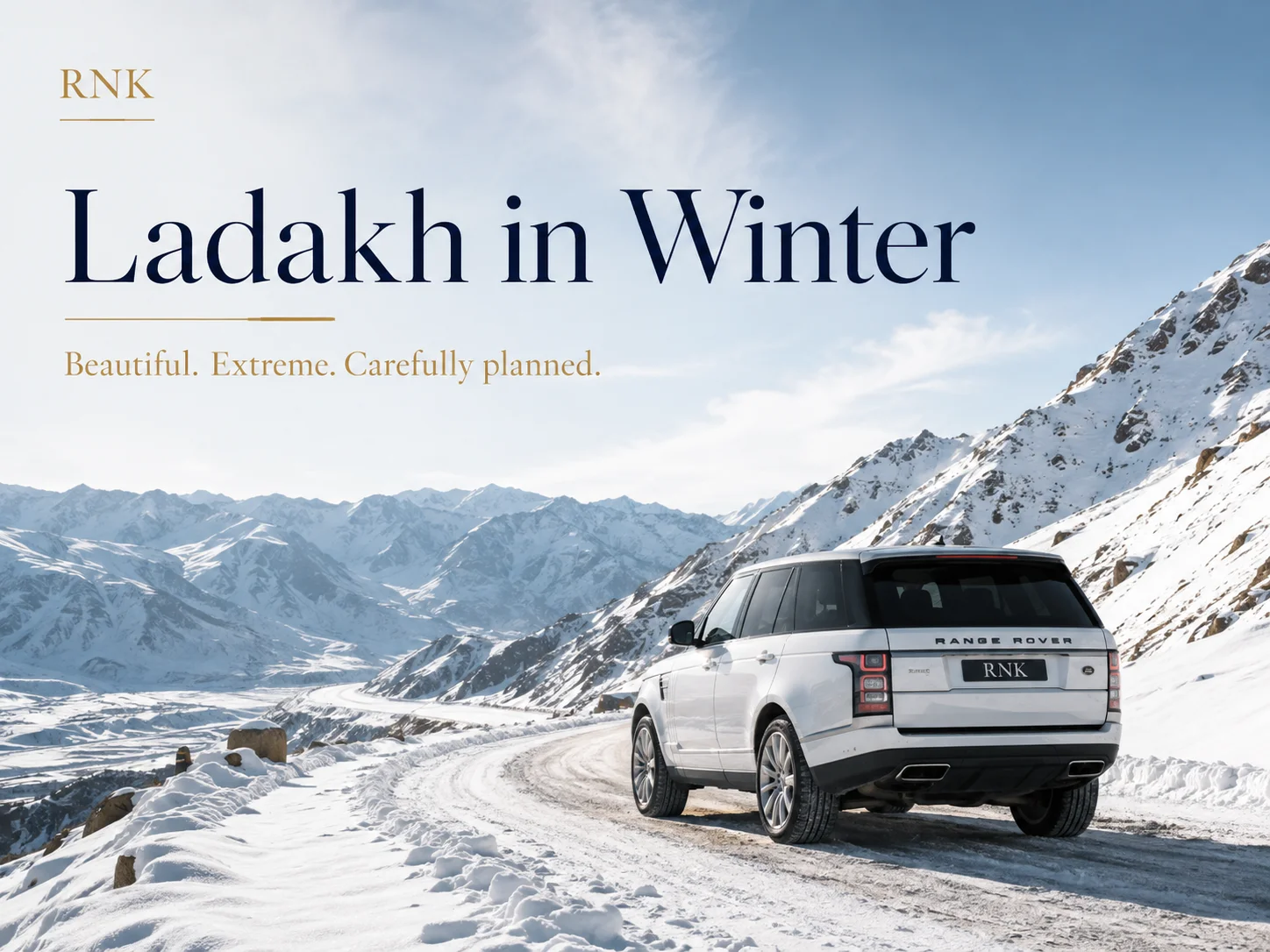
Winter Ladakh is extraordinary.
The crowds that define the warmer travel season disappear. The mountains become sharper and more austere. Pangong Tso can freeze completely, while the combination of snow, clear skies and the region's high-altitude desert landscape creates a visual experience completely different from summer.
The Leh district administration confirms that Pangong Tso freezes completely during winter despite its saline water.
But travellers need to understand one major point before planning anything:
A winter holiday in Ladakh is not the same thing as doing the classic summer road trip into Ladakh.
Official Leh information says the Srinagar–Leh highway generally operates from around May until November or December, while the Manali–Leh highway normally operates from roughly May or June until September or October.
That means the famous Manali-to-Leh drive should not be marketed as a normal deep-winter road trip.
In the core winter months, travellers commonly need to reach Leh by air and then undertake local or regional road journeys only where authorities, weather and current road conditions permit.
That distinction is essential for both safety and accurate trip planning.
RNK's Leh-Ladakh road trip with a chauffeur-driven luxury car is useful for understanding the broader route outside the most restrictive winter periods.
Can You Drive to Leh in Peak Winter?
The answer depends heavily on the route and exact date.
It is not responsible to assume that because a highway appears on Google Maps, it is open for tourist travel.
The official Leh district information clearly describes the major approach roads as seasonal, especially the Manali–Leh corridor.
Winter operations can also change from year to year.
For example, Ladakh authorities regularly undertake snow clearance and winter road-management work, and some corridors may remain operational longer than they historically did. In December 2025, Kargil authorities specifically reviewed efforts to keep Zojila functional for the maximum possible period through winter, demonstrating that winter connectivity is an active operational matter rather than something travellers should assume.
The correct approach is simple.
Do not build a non-refundable luxury itinerary around a particular Himalayan road being open months in advance.
Confirm it closer to travel.
And confirm it through current local administration, police or road advisories rather than only travel blogs.
A Better Way to Experience Ladakh in Winter
For many travellers, a realistic premium winter Ladakh journey begins by flying into Leh.
That does not reduce the road-trip experience.
It simply changes where the road trip begins.
After acclimatisation, travellers may explore routes from Leh according to current access conditions.
This can include nearby monastery circuits, Sham Valley and, when roads and official conditions permit, destinations such as Nubra or Pangong.
The key phrase is when conditions permit.
High passes can be affected by fresh snow and temporary restrictions even when routes are generally maintained.
A luxury itinerary should therefore be built around Leh as a reliable base rather than forcing a new hotel destination every night.
Stay longer.
Drive selectively.
Return to the hotel when conditions become uncomfortable.
That is a far more sophisticated winter strategy than trying to reproduce a summer itinerary in January.
The Mandatory Acclimatisation Rule Matters Even More in Winter
One of the most important things travellers need to understand about Ladakh has nothing to do with the car.
It is altitude.
The Ladakh Tourism travel advisory states that tourists arriving in Leh must undergo at least 48 hours of acclimatisation before travelling towards higher-altitude areas. It also warns of serious high-altitude risks and notes that winter temperatures can fall to around -30°C.
The Leh district administration similarly states that tourists arriving in Leh must complete at least 48 hours of acclimatisation before journeys towards higher areas such as Khardung La and Pangong Lake.
Do not arrive in Leh in the morning and plan Pangong the following day because you want to maximise the itinerary.
That is exactly the type of scheduling luxury travel should avoid.
A better plan gives the body enough time to adjust.
Use the first two days for rest and gentle local activity.
Drink adequately.
Avoid exhausting sightseeing.
And if anyone feels unwell, treat that seriously rather than assuming they simply need more sleep.
The most capable SUV in Ladakh cannot compensate for poor acclimatisation.
Winter Pangong: Spectacular but Not a Casual Excursion
Pangong is one of the most searched winter destinations in Ladakh because of the possibility of seeing the lake frozen.
It sits at more than 14,000 feet, and the official district tourism page confirms that the lake freezes during winter.
That sounds spectacular — and it is.
But it also means travelling at extreme altitude during the coldest part of the year.
This should not be approached like a normal sightseeing drive.
Road access has to be confirmed.
Weather has to be checked.
Accommodation availability needs to be verified.
And travellers should understand that the experience may need to be changed at the last moment.
If the conditions are poor, staying another night in Leh is not a failed itinerary.
It is good itinerary management.
What Makes a Chauffeur Particularly Important in Winter Ladakh?
In summer, travellers unfamiliar with Ladakh already benefit from experienced local driving.
In winter, that advantage becomes considerably more important.
A driver working regularly in the region understands how quickly conditions can change.
They are more likely to recognise places where ice forms repeatedly, stretches that become difficult after snowfall and routes where it is better to wait for clearance rather than continue.
They also understand how altitude affects travel pace.
This is one reason a chauffeur-driven format makes particular sense for winter mountain journeys.
Instead of the passenger concentrating continuously on the road surface, navigation and weather, the traveller can focus on the landscape while the journey is handled by someone experienced with local conditions.
RNK's guide to chauffeur-driven outstation trips and their benefits explains the broader value of professional driving on long-distance itineraries.
Spiti in Winter: One of India's Most Serious Cold-Weather Road Trips
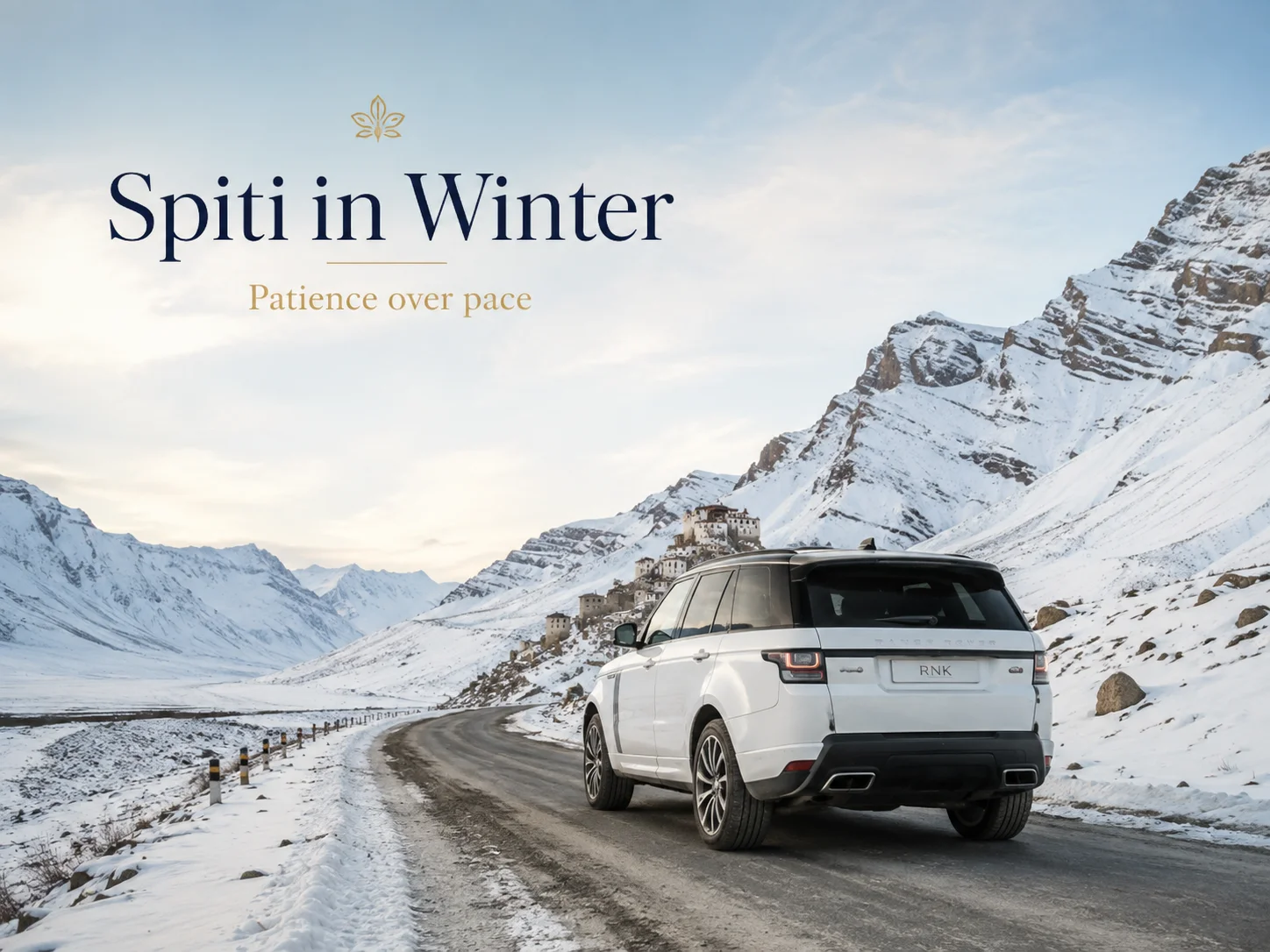
Spiti has developed an almost mythical status among road-trip travellers.
Its monasteries, high villages, barren mountain landscape and isolated roads already feel remote during summer.
Winter intensifies everything.
Himachal Tourism notes that temperatures in Spiti can fall to around -20°C during December to February, while sturdy vehicles are recommended for travel in the region.
Snow can turn valleys almost entirely white.
Tourist numbers fall dramatically.
Villages become quieter.
But accommodation, transport and services also become much more limited.
A winter Spiti road trip is therefore not simply a prettier version of a summer Spiti itinerary.
It is a more demanding journey altogether.
RNK's Manali to Spiti Valley luxury car route tips remain useful for understanding the terrain, but the winter routing strategy needs to be significantly more conservative.
Do Not Assume the Manali–Kaza Route Is a Winter Road
This is one of the most important points in the entire article.
The spectacular summer route from Manali towards Kaza via high passes is seasonal.
Himachal Tourism lists the Manali-side access to Pin Valley via Rohtang and Kunzum as a June-to-October route, while the Shimla–Kinnaur approach has a longer operating season.
Official tourism information on Spiti also notes that regular bus connectivity from Manali to Kaza operates in the warmer months, reinforcing how seasonal the high-pass access is.
For deep-winter Spiti travel, the Shimla–Kinnaur side is generally the relevant approach, but even that should never be assumed open without current verification.
Snowfall, rockfall, ice and temporary restrictions can still affect individual sections.
The route needs to be evaluated immediately before departure.
Why the Shimla–Kinnaur–Spiti Approach Requires Patience
The approach from Shimla towards Kinnaur and eventually Spiti is not a short highway drive.
It is a progressive journey into more demanding terrain.
That makes it well suited to a slower luxury itinerary.
Instead of leaving Chandigarh or Shimla and immediately trying to reach Kaza, the journey should be divided into stages.
This gives passengers time to adapt to elevation.
It reduces chauffeur fatigue.
It creates buffer time for road delays.
And it allows the vehicle to travel primarily during daylight.
Winter mountain roads should rarely be approached with an aggressive arrival target.
If the original plan says six hours and conditions make it eight, the day should simply take eight.
Trying to "recover" time on an icy mountain road defeats the entire purpose of careful planning.
Kaza Should Be Treated as a Base, Not a Checkpoint
Kaza is the administrative centre of Spiti and works naturally as a base for exploring nearby areas when access permits.
Himachal Tourism notes that places such as Key Monastery, Kibber, Langza, Hikkim and Komic lie relatively close to Kaza, making the town strategically useful for regional excursions.
In winter, however, each of those outings has to be treated individually.
Just because one road is clear does not mean the next village route is equally suitable.
Fresh snow or wind can change conditions rapidly.
That makes a multi-night stay far more sensible than designing a circuit where the family is changing accommodation constantly.
The best winter Spiti experience often comes from reducing movement rather than increasing it.
What Luxury Means in Spiti Is Different
Luxury in Rajasthan might mean a palace hotel, exceptional dining and a flagship sedan.
Luxury in winter Spiti means something else.
It means reliable heating.
Hot water that actually works in sub-zero temperatures.
A vehicle that starts every morning.
Enough fuel.
A driver who knows the road.
Warm bedding.
Flexible check-in plans.
Good communication with local hosts.
And the ability to stay an extra night without panicking about the rest of the itinerary.
Premium travel has to adapt to geography.
Trying to impose a metropolitan definition of luxury on an extremely remote Himalayan destination misses the point.
Rajasthan: India's Easier Luxury Winter Road Trip
After Ladakh and Spiti, Rajasthan offers an entirely different winter experience.
It is not included because travellers should expect snow-covered highways.
They generally should not.
It belongs in a winter-road-trip guide because the cooler months are among the most comfortable periods for exploring the state's long heritage circuits by car.
Rajasthan Tourism material identifies December through March as the winter period and notes that December and January are among the coldest months of the year. It also promotes multi-day road circuits linking cities such as Jaipur, Udaipur, Jodhpur, Jaisalmer, Bikaner, Pushkar and Mount Abu.
That makes Rajasthan almost the opposite of Ladakh.
Instead of building the entire trip around snow clearance and extreme weather, travellers can focus on forts, desert landscapes, heritage hotels, cuisine and comfortable long-distance driving.
Why Rajasthan Works So Well in Winter
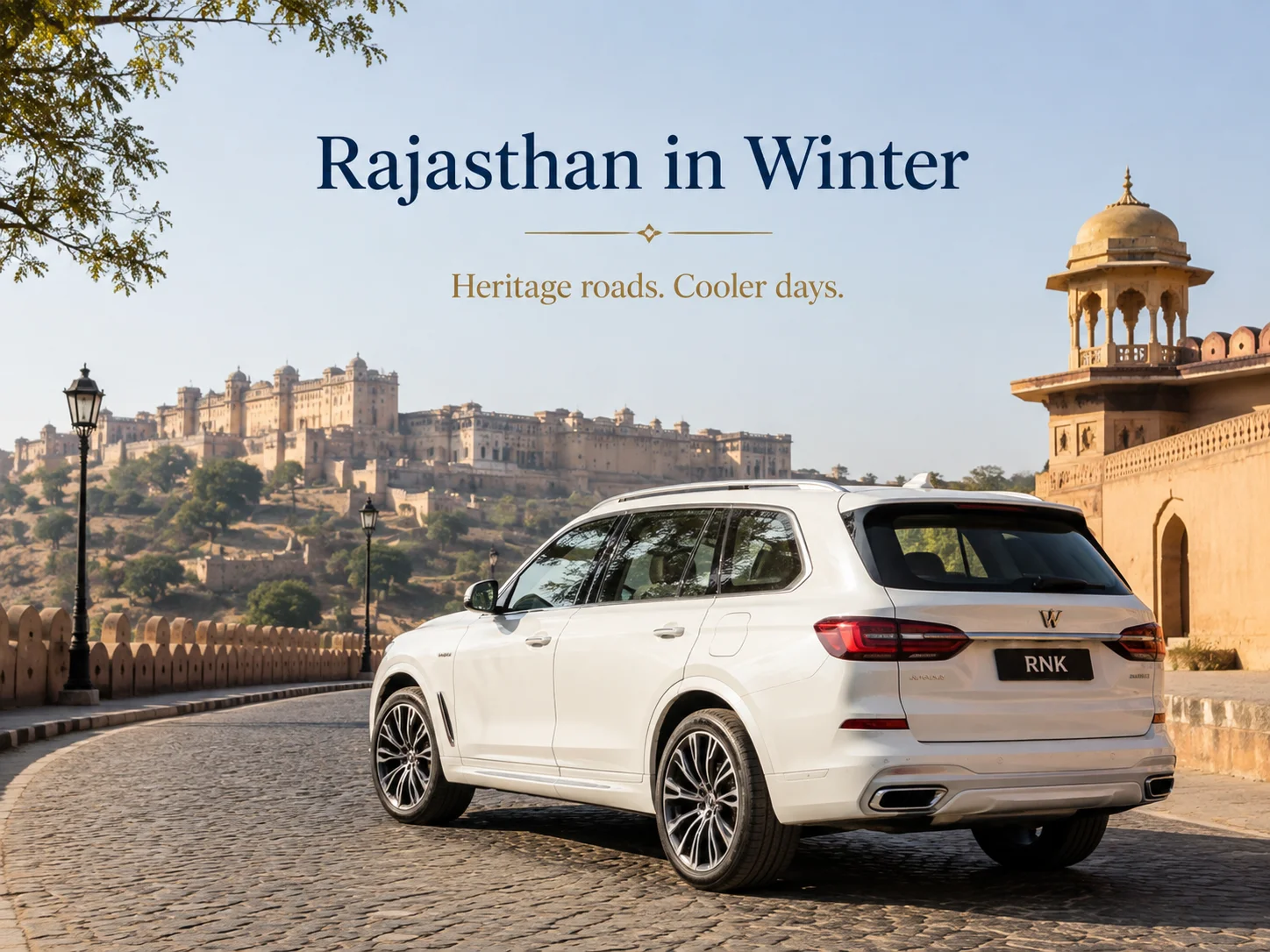
The biggest advantage is daytime comfort.
Long walks through forts and palace complexes are generally more enjoyable during cooler months than during peak summer heat.
Desert drives also become easier.
Evenings can become cold, especially in more open desert regions, but that chill is part of the winter experience rather than the operational challenge it becomes at high altitude.
The roads between major Rajasthan cities also create strong chauffeur-driven itineraries.
A traveller can begin in Jaipur, move towards Jodhpur, continue to Jaisalmer and then create a longer circuit through Udaipur or Mount Abu depending on available time.
This is a road trip where the vehicle can remain a refined part of the experience rather than becoming survival equipment.
Jaipur to Jodhpur: A Strong First Winter Route
For travellers who want heritage and road travel without extreme terrain, Jaipur to Jodhpur is a natural combination.
Jaipur provides forts, palaces and markets.
Jodhpur changes the visual language through Mehrangarh Fort, the old city and the more arid landscapes of western Rajasthan.
The route gives travellers enough time on the road to feel like a genuine driving holiday without requiring the technical planning associated with high-altitude winter travel.
A luxury sedan may work perfectly for this journey.
An SUV becomes useful if the itinerary includes more rural diversions, additional luggage or a larger family.
Jodhpur to Jaisalmer: The Winter Desert Road Trip
The move from Jodhpur towards Jaisalmer creates one of India's classic winter road-trip landscapes.
The terrain becomes more open.
Settlements become more widely spaced.
The desert begins to dominate the visual experience.
This is where a chauffeur-driven vehicle becomes particularly enjoyable because the road itself is a major part of the journey.
Instead of concentrating on navigation and traffic, passengers can watch the landscape change gradually.
Plan the drive during daylight.
Arrive with enough time to settle into the hotel or desert camp before temperatures fall further in the evening.
Winter desert travel still requires warm clothing, even if the daytime sun feels comfortable.
Udaipur and Mount Abu for a Different Rajasthan Winter Experience
Rajasthan does not have to mean only the Thar Desert.
Udaipur adds lakes, palaces and the Aravalli landscape.
Mount Abu introduces Rajasthan's best-known hill-station environment.
These destinations can be incorporated into a longer road itinerary where winter comfort matters more than seeking snow.
A multi-day Jaipur–Jodhpur–Udaipur circuit works particularly well for luxury travellers who want architecture, food and changing scenery without constantly changing the style of transport.
RNK's Golden Triangle luxury road trip from Delhi to Agra and Jaipur can also be combined with a Rajasthan extension for travellers beginning their winter holiday in Delhi.
Ladakh, Spiti or Rajasthan: Which Winter Road Trip Is Right for You?
The answer depends almost entirely on what you want from winter.
Choose Ladakh if you want an extreme high-altitude winter landscape and are comfortable building the entire journey around acclimatisation, road advisories and potentially changing plans.
Choose Spiti if you want a remote snow-covered Himalayan road experience and understand that winter access, accommodation and road conditions demand patience and experienced local planning.
Choose Rajasthan if you want a luxury winter road trip that prioritises heritage hotels, forts, food, desert landscapes and relatively straightforward intercity travel.
They are all winter journeys.
But they should not be sold as though they involve the same level of complexity.
Which Luxury Car Is Best for a Winter Road Trip?
Vehicle selection should begin with terrain.
For Ladakh and Spiti, SUVs are the natural starting point.
Higher ground clearance, an elevated driving position and stronger suitability for uneven or snow-affected roads make them more appropriate than low luxury sedans for demanding mountain sections.
RNK's guide to the best luxury SUVs for Indian road trips provides a broader overview of vehicle selection for long-distance terrain.
For Rajasthan, the choice is wider.
A luxury sedan can be excellent on established intercity roads.
A premium SUV provides additional luggage capacity and flexibility.
Families may prefer an MPV.
The vehicle should fit the journey rather than forcing the journey to fit the vehicle.
Toyota Fortuner for Tougher Winter Routes
The Toyota Fortuner is one of the more logical options when terrain capability matters more than limousine-style luxury.
Its SUV format, clearance and long-distance practicality make it better suited to mountain environments than a low sedan.
But even a capable SUV should never create false confidence.
Four-wheel drive does not make an icy mountain road automatically safe.
Ground clearance does not make deep snow irrelevant.
The chauffeur still needs to evaluate conditions properly.
A vehicle's capability should increase the margin of safety, not encourage more aggressive driving.
Mercedes-Benz GLE for Luxury With SUV Practicality
The Mercedes-Benz GLE can make sense when travellers want a more premium cabin while retaining the advantages of an SUV.
It is particularly attractive for winter journeys where the route remains largely paved but cold weather, elevation and variable road quality favour the SUV format.
For Rajasthan, it provides a comfortable premium option for long multi-city drives.
For Himalayan travel, final vehicle suitability should always be determined against the exact route and prevailing winter conditions rather than simply the model category.
Why a Sedan Makes More Sense in Rajasthan Than Spiti
Winter does not automatically mean SUV.
That is one of the most important vehicle-selection principles.
A Mercedes-Benz E-Class can provide excellent comfort for a Rajasthan circuit on established highways.
The same low-slung luxury-sedan format would not be the first recommendation for a difficult snow-covered Spiti itinerary.
The right vehicle changes with the road.
This is also why RNK's comparison of SUV versus sedan luxury rentals in India is useful before confirming a multi-city journey.
What Should Be Checked Before a Luxury Winter Road Trip?
Winter vehicle preparation should happen before passengers arrive.
Tyres need to be in excellent condition.
The braking system must be checked.
Windshield washers and wipers need to function properly.
The defogging and heating systems should work effectively.
Battery health becomes especially important in very low temperatures.
Coolant and other essential fluids should be suitable for the operating conditions.
Lights must work correctly.
And emergency supplies need to reflect the remoteness of the route.
On specialised snow routes, ask the operator what winter equipment is required for the exact corridor and whether local authorities have issued any specific requirement.
Historic Ladakh road-management instructions have, for example, included directions for vehicles to carry snow chains during December on the Zojila corridor.
The correct equipment should therefore be determined from current local requirements, not from a generic packing list.
Black Ice Is More Dangerous Than Dramatic Snow
Deep snow looks dangerous.
That makes travellers cautious.
Black ice can be harder because the road may appear relatively normal.
Temperatures can fall below freezing overnight, particularly in shaded mountain areas.
A wet-looking section may therefore provide much less grip than expected.
This is another reason winter driving should be concentrated in daylight where possible.
It is also why local experience matters.
An experienced mountain chauffeur may know which stretches repeatedly freeze and which slopes receive little direct sunlight.
The safest winter road trip is not the one driven by the most confident person.
It is the one driven by the person most willing to slow down.
Avoid Unnecessary Night Driving in the Himalayas
Night driving increases several winter risks simultaneously.
The temperature falls.
Ice becomes harder to identify.
Road edges become less visible.
Snowfall reduces visibility further.
And if a vehicle encounters a problem, assistance can be more difficult in remote areas.
Where possible, plan Himalayan travel so that the vehicle reaches the next base comfortably before dark.
This may reduce the number of kilometres covered each day.
That is not a disadvantage.
It is one of the clearest signs that the itinerary has been designed around winter rather than copied from a summer road trip.
Fuel Planning Is Essential in Remote Winter Regions
Do not treat fuel availability casually.
Remote Himalayan routes have fewer opportunities to refuel than major Rajasthan highways.
Winter can reduce the reliability of certain services further.
The vehicle provider should know the entire itinerary and plan fuel accordingly.
Kaza, for example, is identified by Himachal Tourism as having a petrol-diesel filling station and serving as the major administrative base of Spiti.
That does not mean travellers should simply drive until the gauge is nearly empty.
Refuel conservatively.
Keep enough margin for diversions or delays.
A winter itinerary should assume that plans may change.
Heating Matters More Than Fancy Features
Luxury-car marketing often focuses on screens, ambient lighting and entertainment.
Winter mountain travel changes the priorities.
A powerful and reliable heating system becomes one of the most valuable features in the vehicle.
So does fast windshield defogging.
Seat comfort matters because passengers may spend several consecutive hours inside the car.
Charging ports matter because phones are used for communication, maps and photography.
A reliable battery matters more than almost any cosmetic feature.
This is why travellers should ask practical questions when booking.
The most luxurious vehicle is the one that works perfectly throughout the environment you are travelling in.
Pack for the Road, Not Only the Hotel
Winter mountain travellers should keep essential layers inside the cabin.
Do not place every jacket inside luggage that becomes difficult to access.
Carry gloves, caps, thermal layers, water, personal medication, charging equipment and other essentials where passengers can reach them.
Cold-weather footwear matters.
Sunglasses can also be important because bright sunlight reflecting from snow can become uncomfortable even when temperatures are extremely low.
For longer itineraries, RNK's road trip packing list for luxury travellers provides a broader framework.
In Ladakh and Spiti, winter packing should always be more conservative than the minimum.
Children and Elderly Travellers Need Additional Planning
A winter road trip may look spectacular in photographs but may not suit every traveller equally.
High altitude is particularly important.
Families travelling with elderly passengers, younger children or anyone with relevant health concerns should seek appropriate medical advice before committing to an extreme-altitude itinerary.
Do not assume that because one member of the family has previously visited a hill station, they will respond comfortably to Leh or high Spiti.
These are very different elevations.
A Rajasthan winter trip may provide a better alternative for a multi-generational family that wants long scenic drives without the physiological demands of extreme altitude.
Luxury travel should match the traveller, not the social-media image of the destination.
Why Chauffeur-Driven Is Usually Better for Winter Mountain Routes
Self-driving offers independence.
Winter mountains demand concentration.
A professional chauffeur reduces the number of things travellers themselves need to manage.
There is no pressure to understand unfamiliar road behaviour.
No need to continuously monitor directions while simultaneously watching for ice.
No need to drive after a tiring day of sightseeing.
And no temptation for one family member to push through difficult conditions because the hotel has already been booked.
RNK's comparison of chauffeur-driven versus self-drive luxury cars explains this trade-off in more detail.
For serious winter mountain routes, professional local road experience should be treated as part of the safety planning rather than only a luxury service.
Build Buffer Days Into Ladakh and Spiti
A seven-day itinerary containing exactly seven days of planned movement has no resilience.
That is risky in winter.
A good Himalayan itinerary should contain buffer time.
A snowfall may delay departure.
A pass may temporarily close.
The family may need another day to acclimatise.
The chauffeur may recommend waiting until ice clears.
If the itinerary has no margin, travellers begin making decisions based on hotel reservations rather than road conditions.
That is the wrong priority.
A luxury itinerary should make it financially and logistically possible to change plans.
Do Not Pre-Book Every Winter Activity Too Tightly
The same principle applies to sightseeing.
Avoid placing high-altitude excursions, special meals and hotel transfers into a sequence where delaying one event destroys the rest.
Winter is unpredictable.
The itinerary should have one or two major objectives per day rather than six.
The more difficult the route, the simpler the daily plan should become.
This gives travellers more freedom to enjoy the landscape when conditions are good and remain comfortable when they are not.
Common Mistakes to Avoid on Winter Luxury Road Trips
The first mistake is assuming four-wheel drive makes a journey safe regardless of conditions.
It does not.
The second is planning Ladakh's summer approach highways as if they operate normally in January.
Official Leh guidance makes clear that the major road approaches are seasonal.
The third is failing to acclimatise after reaching Leh.
The fourth is planning extremely long mountain driving days.
The fifth is treating every snowfall as an invitation to keep driving rather than a reason to reassess the road.
Another mistake is expecting the same kind of "luxury" everywhere.
In remote Spiti, dependable heating and an experienced chauffeur may be more valuable than a luxury-brand badge.
And finally, do not market Rajasthan as a reliable snow-driving destination.
Its strength is that winter makes its desert and heritage routes comfortable, not that its highways normally become snow-covered.
How Far in Advance Should You Book?
Luxury vehicles and experienced chauffeurs can become limited during popular holiday periods.
Booking early therefore helps.
However, Himalayan road status should still be treated as provisional.
You can reserve the broader journey in advance while keeping route-specific decisions flexible.
The operator should know which parts of the itinerary are fixed and which need to remain weather-dependent.
For Rajasthan, planning can generally be more structured because the major heritage-road itinerary is not dependent on high-altitude snow clearance.
For Ladakh and Spiti, weather always receives the final vote.
Frequently Asked Questions
What are the best winter road trips in India?
For snow and high-altitude landscapes, carefully planned Ladakh and Spiti journeys are among India's most dramatic options. For easier premium winter touring, Rajasthan offers excellent heritage and desert circuits through destinations such as Jaipur, Jodhpur, Jaisalmer and Udaipur.
Can you do a Ladakh road trip in winter?
You can travel within Ladakh during winter where local roads and current conditions permit, but the classic highway approach into Leh is seasonal. The Manali–Leh and Srinagar–Leh highways should not be assumed open during peak winter. Many winter visitors therefore reach Leh by air and begin their road travel from there.
Is Manali to Leh open in December or January?
The official Leh district page states that the Manali–Leh highway generally operates from around May or June to September or October, so it should not be planned as a normal December or January tourist road route.
Can tourists visit Pangong Lake during winter?
Winter access may be possible depending on prevailing road and weather conditions. Pangong itself freezes during winter, but tourists should confirm current access and complete the required acclimatisation before travelling to higher-altitude areas.
How many days should you acclimatise in Leh?
Current Ladakh Tourism and Leh district guidance requires at least 48 hours of acclimatisation for tourists arriving in Leh before travelling to higher-altitude locations.
Is Spiti open in winter?
Parts of Spiti can be accessed in winter depending on current road conditions, but high-pass routes are highly seasonal. Travellers should verify the exact approach immediately before the journey and should not assume that the Manali–Kaza summer route remains available in deep winter.
Which route is better for winter Spiti?
The Shimla–Kinnaur side generally provides the relevant approach when the high Manali–Kunzum route is seasonally inaccessible. However, winter road status can change and must be checked before departure.
How cold does Spiti get in winter?
Himachal Tourism notes that temperatures in Spiti can fall to around -20°C during December to February.
Which car is best for winter Ladakh or Spiti?
A capable high-ground-clearance SUV is generally more appropriate than a low sedan for demanding snow-affected mountain routes. The exact vehicle should be selected according to the route, current conditions and operator guidance.
Is Toyota Fortuner good for winter mountain road trips?
Its high-ground-clearance SUV format makes the Fortuner a practical option for difficult mountain travel, but vehicle capability does not replace winter-road experience, appropriate tyres, current road clearance or safe driving decisions.
Is Mercedes-Benz GLE suitable for a winter road trip?
The GLE can provide premium SUV comfort for suitable winter routes. Its appropriateness for extreme snow conditions should still be assessed against the exact road and weather conditions.
Is Rajasthan a snow road-trip destination?
Not in the same sense as Ladakh or Spiti. Rajasthan is better positioned as a luxury winter road-trip destination because of its cooler weather, heritage routes and desert landscapes. Regular snow-covered highways should not be expected.
What is the best Rajasthan winter road trip?
Jaipur–Jodhpur–Jaisalmer is an excellent winter circuit for desert and heritage travel. Travellers with additional time can extend towards Udaipur or Mount Abu.
Is a sedan suitable for a Rajasthan winter road trip?
Yes. On established intercity roads, a premium sedan can provide excellent comfort. Families, larger groups or travellers carrying substantial luggage may prefer an SUV or MPV.
Is chauffeur-driven better for snow road trips?
For unfamiliar high-altitude winter routes, an experienced professional chauffeur is usually the more comfortable and sensible option because snow, ice, road closures and changing mountain conditions require continuous attention.
Should winter road trips include buffer days?
Yes, particularly in Ladakh and Spiti. Weather or road closures can delay travel, so an itinerary with no spare time can create pressure to travel when conditions are unsuitable.
Should you drive at night in Ladakh or Spiti during winter?
Unnecessary night driving should generally be avoided. Lower temperatures, ice, reduced visibility and remote terrain can make nighttime winter travel significantly more demanding.
When is the best season for a Rajasthan luxury road trip?
The cooler winter months are particularly comfortable for extended sightseeing and intercity road travel, especially compared with the much hotter summer period. Rajasthan Tourism identifies December to March as the winter season.
Final Takeaway
Winter creates some of India's most beautiful road-trip landscapes.
But it also exposes the difference between a journey that looks luxurious and one that has actually been planned luxuriously.
In Ladakh, premium travel begins with respecting altitude.
It means allowing the required acclimatisation period, accepting that the major approach highways are seasonal and planning regional road travel according to current conditions rather than a fixed social-media itinerary.
In Spiti, luxury means patience.
It means understanding that the Manali-side high-pass route is not an ordinary deep-winter road, that the Kinnaur approach needs time and that a comfortable base in Kaza can be more valuable than changing hotels every night.
In Rajasthan, winter luxury takes a completely different form.
The challenge of snow disappears and the pleasure of the road becomes the focus.
Cooler temperatures make forts, palace cities, desert roads and long chauffeur-driven journeys significantly more comfortable. Jaipur, Jodhpur, Jaisalmer, Udaipur and Mount Abu can become part of a winter itinerary where the road is not something to overcome but something to enjoy.
The vehicle also needs to change with the destination.
A capable SUV makes sense when terrain becomes difficult.
A refined luxury sedan may be the better choice for Rajasthan's established highways.
A larger MPV can be more comfortable for families.
There is no single "best luxury winter car" for India because there is no single type of Indian winter road.
The strongest itinerary matches the car to the most demanding section of the actual journey.
And above everything else, the weather must remain more important than the schedule.
A luxury booking should never force a chauffeur to cross a pass that local authorities recommend avoiding.
A hotel reservation should never become a reason to keep moving when visibility deteriorates.
A pre-planned sightseeing stop should never be more important than acclimatisation.
That is what truly separates premium winter travel from an ordinary road trip.
The heated seats, spacious cabin and luxury hotel matter.
But in Ladakh and Spiti, the greatest luxury is having enough time, the right vehicle and an experienced chauffeur to wait when the mountains tell you to wait.