Employee Transportation Solutions Guide
“Our company is expanding. How do we manage daily employee transportation efficiently and safely?”
As organisations grow in scale and complexity, employee transportation evolves from a basic commuting arrangement into a structured operational requirement. Companies with expanding workforces, multiple shifts, or offices located in high-density business districts often face challenges related to punctuality, attendance delays, and increasing transportation costs.
In India, these challenges are amplified by traffic congestion, long commuting distances, and inconsistent public transport connectivity. Employees often spend significant time traveling between home and workplace, which can lead to fatigue and reduced productivity. When commuting becomes unpredictable, it directly affects workforce efficiency and overall business performance.
To address these issues, companies are increasingly investing in organised employee transportation systems. These systems are designed to provide reliable, safe, and cost-effective commuting solutions that align with operational requirements. A well-structured transport program ensures that employees reach their workplace on time while reducing logistical stress.
Employee transportation, therefore, becomes a strategic function that supports both operational continuity and employee well-being.
Clear Answer Upfront
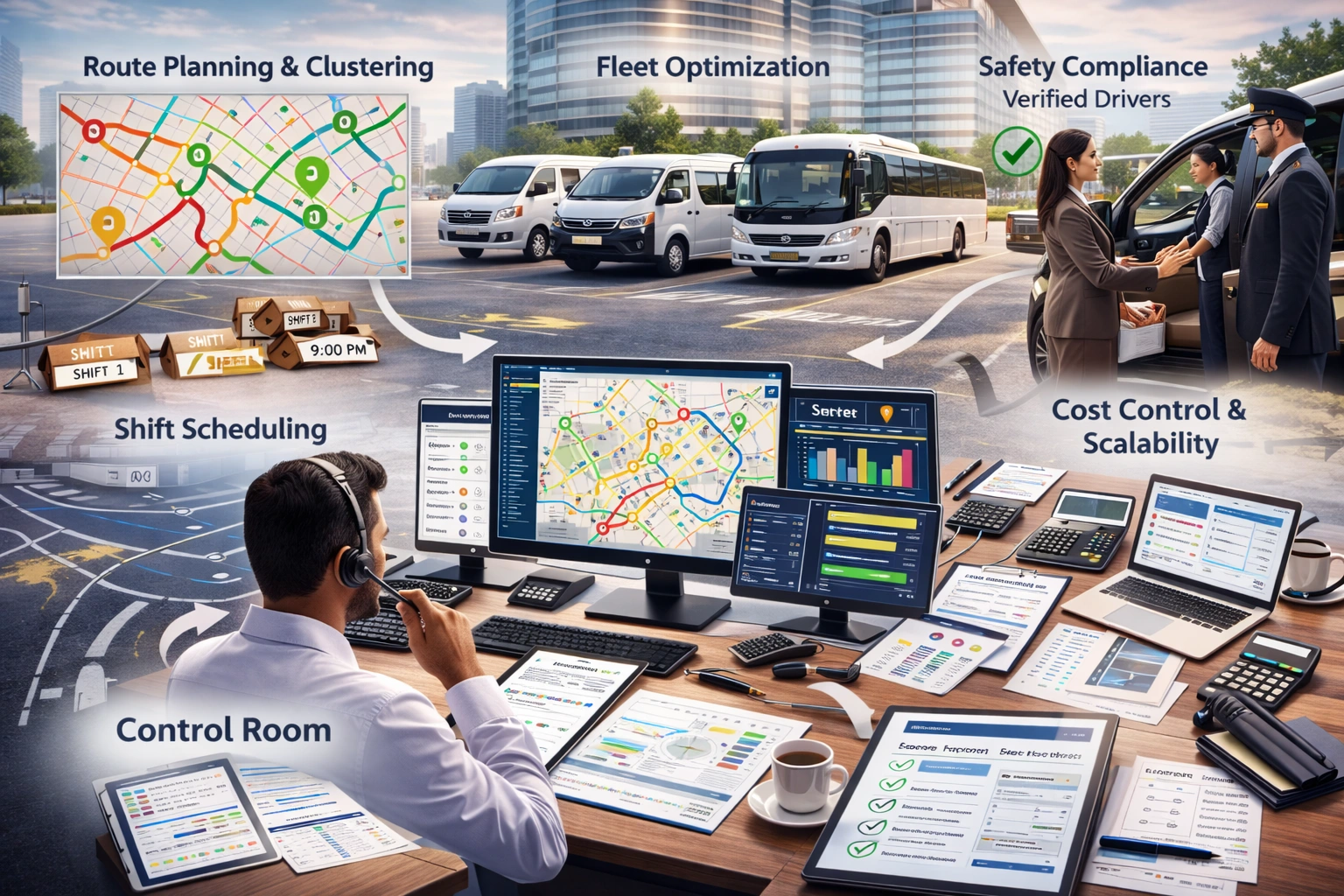
Employee transport services in India require a structured and integrated system that combines route planning, fleet optimisation, safety compliance, driver verification, shift-based scheduling, GPS tracking, and centralised coordination.
When these elements are implemented effectively, organisations can ensure that employees travel safely, reach the workplace on time, and experience minimal commuting stress. At the same time, companies can control operational costs and improve overall efficiency.
A professional employee transportation system is not just about moving people—it is about managing mobility in a predictable, scalable, and compliant manner.
Why Employee Transportation Is Critical in India
Daily commuting challenges significantly impact employee performance and business productivity. In cities such as Mumbai, Bengaluru, Delhi, and Hyderabad, employees often face long travel hours due to heavy traffic and limited public transport reliability.
When employees consistently arrive late or fatigued, it affects their ability to perform effectively. Over time, this can reduce overall productivity and increase employee dissatisfaction. Companies that ignore transportation challenges may also face higher attrition rates, especially in competitive industries.
Providing structured transportation helps organisations create predictable commute schedules. Employees feel more secure knowing that their travel is organised, particularly during early morning or late-night shifts. This reliability improves attendance and morale while supporting smooth business operations.
Route Planning and Cluster Mapping
Efficient route planning is the foundation of any successful employee transportation system. Companies group employees based on their residential locations to create geographic clusters. Vehicles are then assigned to these clusters to follow optimised routes.
Instead of picking up employees individually from multiple scattered locations, fixed pickup points are established within each cluster. This reduces travel time and allows vehicles to maintain consistent schedules.
Advanced route planning also considers traffic patterns and peak hours. By continuously analysing and refining routes, companies can improve efficiency and reduce fuel consumption. Proper cluster mapping ensures that transportation remains both cost-effective and reliable.
Shift-Based Transport Scheduling
Organisations with multiple shifts require carefully planned transportation systems that align with employee work schedules. Early morning, late evening, and overnight shifts each require specific transport arrangements.
Vehicles must be scheduled according to shift timings to ensure smooth employee movement. Staggered shifts can also help distribute transportation demand evenly across the fleet, reducing congestion and delays.
Night-shift transportation requires additional safety measures, including route monitoring and secure drop-off procedures. Proper scheduling ensures that employees can travel safely regardless of their working hours.
Fleet Optimisation and Vehicle Selection
Selecting the right mix of vehicles is essential for efficient employee transportation. Companies typically use a combination of cars, vans, and buses depending on the number of employees on each route.
Smaller vehicles are suitable for routes with fewer employees, while larger buses are more efficient for high-density areas. Choosing the correct vehicle type helps avoid unnecessary fuel costs and ensures comfortable travel.
Fleet optimisation also involves balancing vehicle capacity with demand. By aligning resources effectively, companies can reduce operational costs while maintaining service quality.
Safety and Compliance Measures
Safety is one of the most critical aspects of employee transportation. Companies must ensure that vehicles are well-maintained, properly registered, and operated by trained drivers.
Driver verification, background checks, and training programs help ensure that chauffeurs follow safe driving practices. Monitoring driver working hours also reduces fatigue-related risks.
Modern transport systems include GPS tracking, emergency alert systems, and real-time monitoring. For night shifts, additional safety protocols such as drop confirmations and route tracking are implemented.
These measures ensure that employees can travel safely under all conditions.
Real-Time Tracking and Transport Coordination
Technology plays a vital role in modern employee transportation systems. GPS tracking allows companies to monitor vehicle movement in real time and ensure adherence to schedules.
Transport control teams can use this data to adjust routes during traffic congestion and maintain operational efficiency. Real-time tracking also improves safety by enabling quick responses to unexpected situations.
Transport management systems generate reports on attendance, delays, and route performance. These insights help companies optimise their transportation strategy and improve service quality.
Cost Management and Contract Planning
Managing transportation costs is essential for long-term sustainability. Employee transport services are usually governed by contracts between companies and service providers.
Pricing models may include per-vehicle monthly rates, per-kilometre billing, or per-seat costs. The choice depends on company requirements and employee volume.
Clear contract terms help avoid hidden costs related to overtime, idle time, or additional kilometres. By maintaining stable routes and predictable demand, companies can achieve cost efficiency without compromising service quality.
Scalability and Future Growth
As organisations expand, transportation systems must adapt to increased demand. Scalable solutions allow companies to add routes, vehicles, and schedules without disrupting operations.
Professional transport providers offer flexible services that grow with the organisation. This ensures that employee mobility remains efficient even as workforce size increases.
Scalability is essential for maintaining long-term operational efficiency.
Frequently Asked Questions
Q1. Is employee transportation mandatory for companies in India?
Employee transportation is not legally mandatory for all companies, but it becomes essential in industries that operate multiple shifts or require employees to travel during early morning or late-night hours. Many organisations provide transport as part of employee welfare and operational efficiency.
A structured transport system helps ensure punctuality, improves employee safety, and reduces absenteeism. For night shifts, especially involving women employees, companies often implement transportation as part of internal safety policies.
Q2. Why is employee transportation important for productivity?
Employee transportation directly impacts productivity because it ensures that staff reach the workplace on time and without stress. Long or unreliable commutes can lead to fatigue, delays, and reduced work efficiency.
When companies provide organised transportation, employees can focus better on their work. Over time, this leads to improved performance, better attendance, and higher job satisfaction.
Q3. How does route planning improve transport efficiency?
Route planning improves efficiency by grouping employees into clusters and designing optimised routes. This reduces travel time, fuel consumption, and operational costs.
Instead of scattered pickups, vehicles follow fixed routes with designated stops. This ensures consistent schedules and better utilisation of resources.
Q4. What role does GPS tracking play in employee transport?
GPS tracking allows companies to monitor vehicle movement in real time, ensuring safety and schedule accuracy. It helps identify delays, optimise routes, and improve operational control.
In case of emergencies, tracking systems enable quick response and communication. This technology enhances both safety and efficiency.
Q5. How is employee transport pricing structured?
Pricing is usually based on contracts that include per-vehicle, per-kilometre, or per-seat billing. Costs depend on route distance, vehicle type, and operational hours.
Clear agreements help companies avoid unexpected expenses and maintain financial control.
Q6. What safety measures are required in employee transport systems?
Safety measures include driver verification, vehicle maintenance, GPS tracking, and emergency response systems. Night-shift transport requires additional monitoring and safety protocols.
These measures ensure that employees travel securely at all times.
Q7. Can employee transport systems scale with company growth?
Yes, professional transport systems are designed to scale. Companies can expand routes, increase fleet size, and adjust schedules as their workforce grows.
Scalable systems ensure long-term efficiency and adaptability.
Q8. How can companies reduce employee transport costs?
Companies can reduce costs by optimising routes, selecting the right vehicle mix, and maintaining stable schedules. Efficient planning helps balance cost and service quality.
Regular monitoring and vendor negotiation also contribute to cost control.
Conclusion
Employee transportation in India is a critical component of modern business operations. A well-structured transport system improves punctuality, enhances safety, and supports workforce productivity.
By combining route planning, fleet optimisation, safety measures, and technology, companies can create a reliable and cost-effective transportation solution. As organisations grow, scalable transport systems ensure continued efficiency.
Contact RNK Rentals
Looking for reliable employee transportation solutions for your company?
RNK Rentals provides professional, safe, and scalable employee transport services tailored to your business needs.
📞 Call us: +91 9167977799 ✉️ Email: info@rnk.com
Book your corporate employee transport service today and ensure smooth, safe, and efficient workforce mobility.