
Most corporate event logistics failures aren't dramatic — nobody's car breaks down on the highway, no venue collapses mid-event. They're small, avoidable planning gaps that quietly compound: a VIP guest left waiting at arrivals, a shuttle schedule nobody bothered to communicate, a budget that didn't account for peak-hour surge pricing. Individually minor, collectively they're what separates an event that feels effortless from one that feels like it barely held together.
This guide walks through the most common corporate event logistics mistakes companies make in India, specifically around transportation, and what to do instead.
Mistake 1: Treating Transportation as an Afterthought

The single most common mistake is booking transportation last, after the venue, catering, and program are already locked in — which leaves little room to plan properly and even less room to fix problems if something doesn't work.
Transportation deserves the same lead time as any other major event component, particularly for events involving VIP guests, multiple venues, or out-of-town attendees. Our broader guide to corporate event transportation planning covers how to build this into the planning timeline from the start rather than treating it as a last-minute logistics task.
Mistake 2: Not Separating VIP Transport From General Attendee Logistics
Many companies plan one undifferentiated transportation pool for the entire guest list, which almost always under-serves VIP guests and over-serves general attendees relative to what each group actually needs.
VIP and senior leadership transport needs a dedicated vehicle, a vetted driver, and a named point of contact who can adjust in real time — a shared shuttle system simply isn't built for that standard. Our guide on luxury cars for CXOs and board members and our piece on how MNCs handle VIP guest transportation in India both cover why this distinction matters and how mature programs handle it.
Mistake 3: Underestimating Travel Time and Traffic Buffers
A transfer time that looks fine on a map often doesn't hold up against real city traffic, particularly during peak hours or in cities like Mumbai where transit times can shift dramatically within the same day.
Building in realistic, route-specific buffers — rather than a flat estimate applied across the whole event — is one of the simplest fixes with the biggest impact. Our corporate event transportation in Mumbai guide covers exactly this kind of city-specific timing planning in more depth.
Mistake 4: Poor Airport and Railway Pickup Coordination
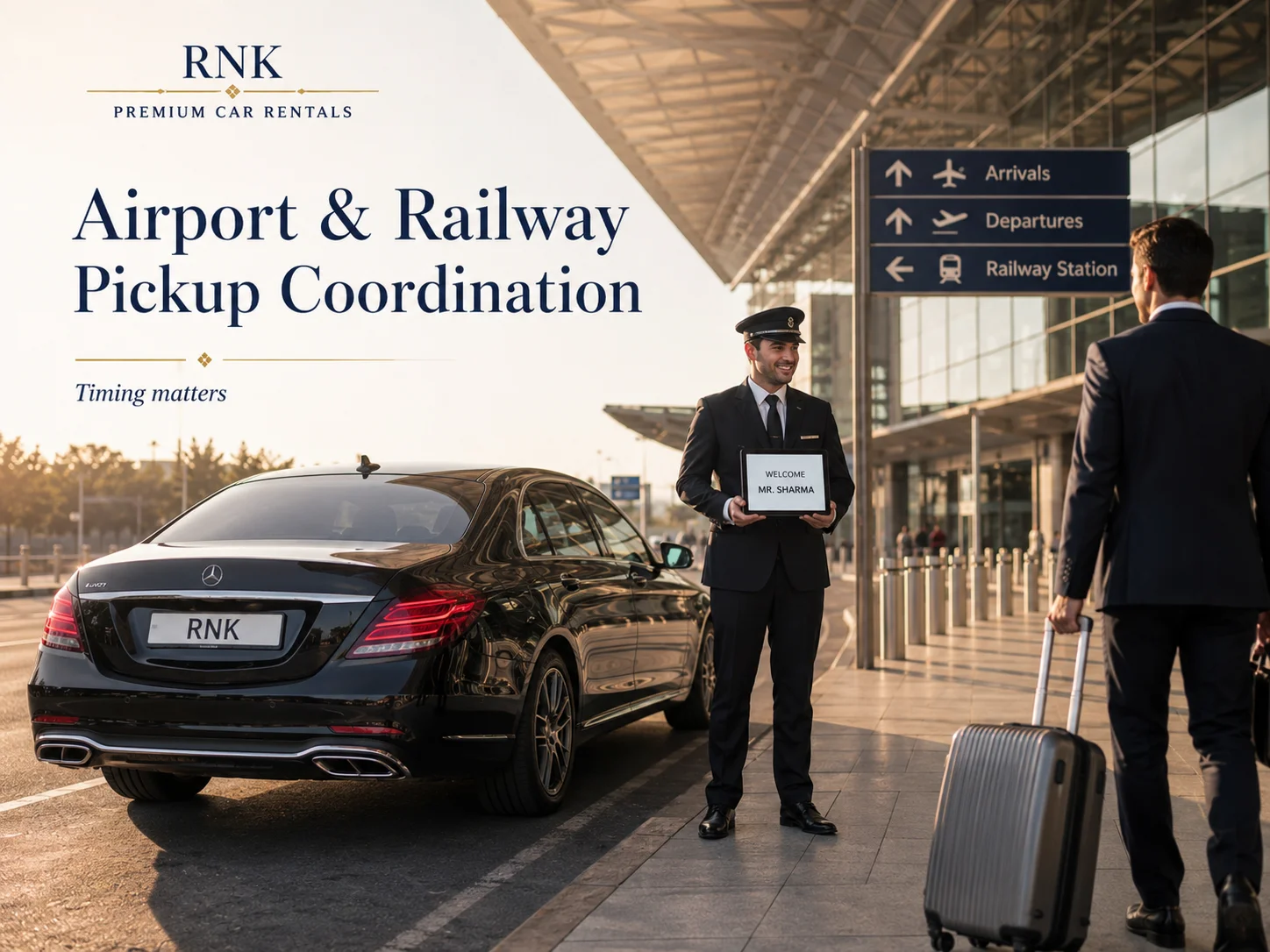
Airport and railway transfers depend on flight and train schedules that shift in ways outside anyone's control, and treating them with the same fixed-timing logic as on-the-ground event movement is a common and costly mistake.
Without real-time flight tracking and realistic buffers for immigration and baggage claim, guests end up waiting at arrivals while a car is scrambled together, or a vehicle sits idle waiting for a flight that's already landed. Our guide to airport-to-event transfer planning for corporate guests and our airport and railway transfers service page both cover how this should actually be structured.
Mistake 5: Not Planning for Staggered Arrivals
Most events don't have a single, clean arrival window — guests trickle in across a full day or multiple days, often on different flights from different cities — but transportation plans frequently assume a single arrival burst.
Booking a fixed number of vehicles for one assumed arrival time, rather than keeping a flexible fleet on standby across the full expected window, is a mistake that shows up repeatedly at multi-day conferences and summits. Our guide to event transportation for large gatherings covers how to size a fleet properly against a spread-out arrival pattern instead.
Mistake 6: Underestimating the Return-Trip Volume
Companies plan carefully for guests arriving at an event and then significantly underplan the return trip — the point at the end of a session or function when a large number of people all want to leave at roughly the same time.
This peak return window is consistently the most common failure point in event transportation, more so than the outbound journey. Sizing shuttle capacity around this peak, rather than the more gradual arrival pattern, is one of the most impactful fixes companies can make.
Mistake 7: Skipping Driver Vetting and Safety Standards
For events involving senior leadership, external clients, or media, cutting corners on driver vetting and vehicle safety standards is a mistake that carries real reputational and liability risk, not just an inconvenience.
Confirming driver background checks, training standards, and vehicle maintenance protocols should be a standard part of vendor evaluation, not an afterthought. Our guide on safety standards in corporate mobility and our piece on luxury car rental safety and chauffeur standards cover exactly what to confirm before committing to a vendor.
Mistake 8: Booking Multiple Disconnected Vendors
Splitting transportation across several separate vendors — one for airport transfers, another for on-the-ground shuttles, a third for VIP cars — creates unnecessary coordination overhead and multiple points of failure.
A single coordinated provider managing the full event's transportation, from airport pickup through departure, reduces handoff points and keeps timing consistent throughout. Our guide on why MNCs prefer premium chauffeur services covers why this consolidated approach has become standard practice for companies that run events regularly.
Mistake 9: Not Getting Itemized Budget Quotes
A single bundled quote makes it difficult to understand what's actually being paid for, and it makes comparing vendors or catching hidden costs — like surge pricing, overtime, or parking — much harder after the fact.
Requesting itemized quotes by transport category (VIP, general shuttle, airport transfers) and confirming whether pricing changes by distance, duration, or time of day prevents budget surprises. Our guide on luxury car rental cost in India explained breaks down the cost factors worth understanding before finalizing any transportation budget.
Mistake 10: Not Assigning a Single Point of Coordination
When transportation issues arise on the day of the event — and something almost always shifts — having no clear, single person responsible for resolving it in real time is one of the most common and most damaging mistakes.
A named point of contact with visibility into the full transportation plan, and the authority to adjust timing or reroute vehicles as needed, is what actually prevents small issues from cascading into bigger ones. Our event transportation checklist for HR and admin teams covers this and the rest of the planning process in a structured, step-by-step format.
Mistake 11: Failing to Communicate the Plan to Attendees
Even a well-built transportation plan fails if attendees don't actually know what's expected of them — where to be, when, and who to contact if something changes.
Sharing pickup times, locations, and driver contact details well before the event, rather than the morning of, is a simple step that prevents a large share of on-the-ground confusion.
Mistake 12: Not Building In a Reconfirmation Step
Event schedules shift in the days leading up to the event more often than most planners expect, and transportation plans built weeks in advance can quietly go stale if nobody checks back in.
Reconfirming every vehicle, driver, and pickup time with the vendor 24-48 hours before the event catches these last-minute shifts before they become day-of surprises.
How to Avoid These Mistakes: A Quick Reference
Most of these mistakes trace back to the same root cause — treating transportation as a single, undifferentiated task rather than several distinct planning tracks (VIP, general shuttle, airport/railway, budget, communication) that each need their own attention. Our corporate event transportation checklist for HR and admin teams walks through all of these tracks as a structured, repeatable process rather than something to figure out fresh for every event.
Frequently Asked Questions
What's the most common corporate event transportation mistake? Treating transportation as an afterthought and booking it last, after the venue and program are already finalized — this leaves little room to plan properly or fix problems if something doesn't work.
Why is separating VIP transport from general attendee transport so important? VIP guests typically need a dedicated vehicle, vetted driver, and real-time point of contact, while general attendees can be served well by a fixed shuttle schedule — treating both groups the same under-serves one or over-serves the other.
What's the biggest logistics risk at the end of an event, not the start? The return-trip window, when a large number of guests leave at roughly the same time, is consistently a bigger failure point than the outbound arrival, yet it's often under-planned.
Should companies use multiple transportation vendors for one event? Generally no — a single coordinated provider managing the full event reduces handoff points and keeps timing more consistent than splitting logistics across several disconnected vendors.
How close to the event should transportation be reconfirmed? Ideally 24-48 hours before the event, to catch any last-minute schedule changes that may have occurred since the original booking.
The Bottom Line
Most corporate event logistics failures come down to a handful of repeatable, avoidable mistakes — treating transportation as an afterthought, under-planning VIP logistics, underestimating traffic and return-trip volume, and skipping reconfirmation. Companies that plan transportation as its own dedicated track, with the same rigor as venue and catering, consistently run smoother events than those that don't.
Planning your next corporate event and want to avoid these common pitfalls? Get in touch with our team to build a coordinated transportation plan, or explore our corporate car rental services to see what's available.