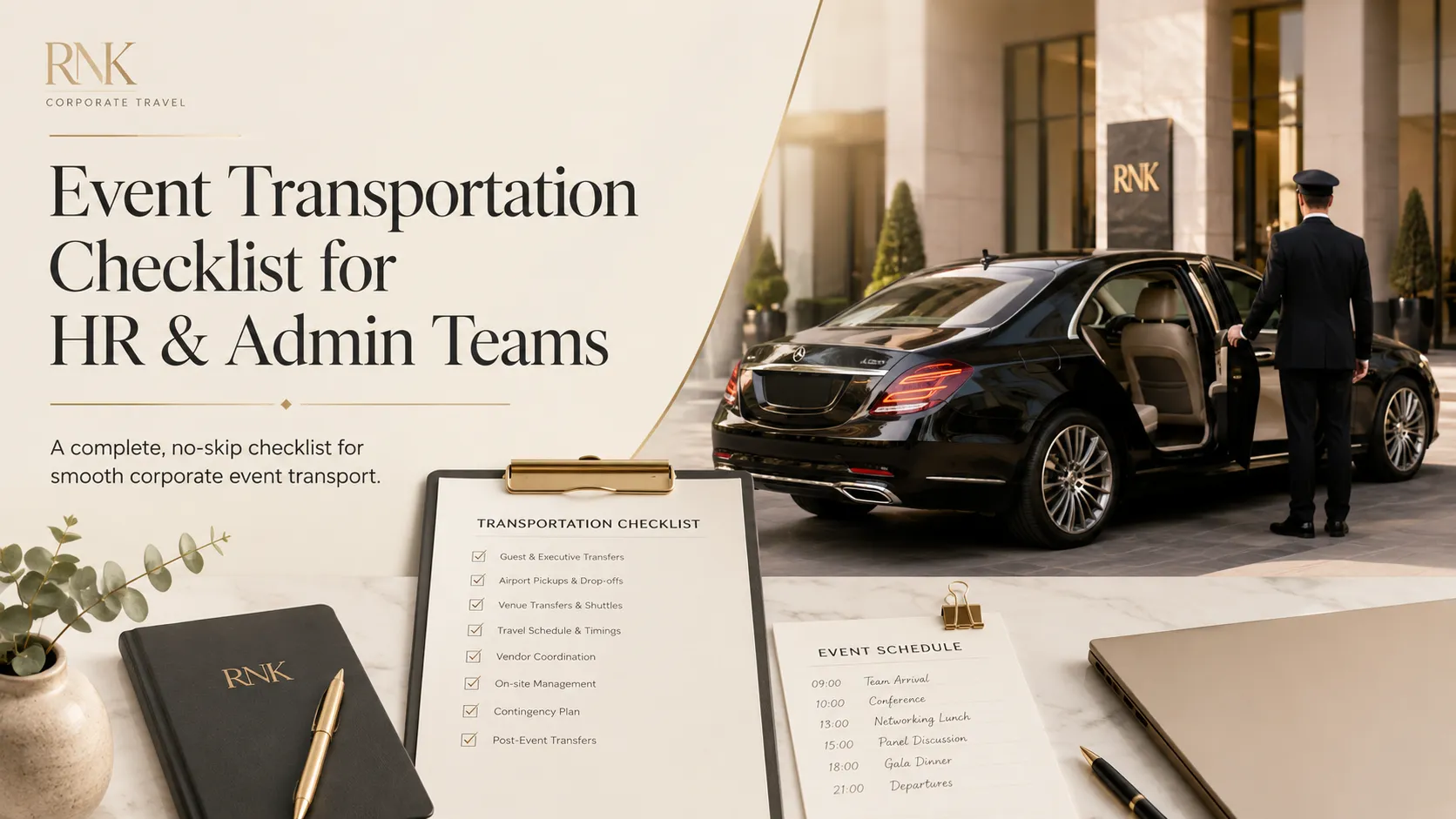
For most HR and admin teams, event transportation isn't the headline part of the job — it's the operational layer underneath a conference, an offsite, an annual day, or a client event that quietly determines whether the day runs smoothly or turns into a stream of "where's my cab" messages. Unlike a dedicated events agency, HR and admin teams are often managing transportation alongside a dozen other responsibilities, which makes a clear, repeatable checklist genuinely useful rather than optional.
This guide walks through everything an HR or admin team should confirm when planning event transportation — from vendor selection through day-of coordination — so nothing falls through the cracks when the day actually arrives.
Before You Start: Define the Event's Transportation Scope

Before reaching out to any vendor, it's worth getting clear internally on exactly what transportation the event actually requires — this shapes every decision that follows.
Confirm whether the event needs airport or railway pickups for out-of-town guests, on-the-ground shuttle service between venues or from a hotel block, VIP transport for senior leadership or external guests, and return transfers once the event wraps. Our broader guide to corporate event transportation planning is a useful starting reference for mapping this scope properly.
Checklist:
- [ ] Confirmed whether airport/railway pickups are needed
- [ ] Confirmed on-the-ground shuttle requirements between venues
- [ ] Identified which guests need dedicated VIP transport
- [ ] Confirmed return/departure transfer requirements
Choosing a Transportation Vendor
Vendor selection is where most of the downstream reliability of the event actually gets decided, and it's worth evaluating a few specific things beyond just pricing.
Ask about driver vetting and training standards, how the vendor handles real-time schedule changes, and whether they can provide a single point of contact for the full event rather than routing every issue through general customer service. Our guide on safety standards in corporate mobility and our piece on common mistakes to avoid while renting luxury cars both cover questions worth raising before signing off on a vendor.
Checklist:
- [ ] Vendor's driver vetting/training standards confirmed
- [ ] Process for handling delays/schedule changes confirmed
- [ ] Single point of contact assigned for the full event
- [ ] Vendor experience with events of similar scale confirmed
Mapping Guest and Employee Travel Needs
Once the vendor is selected, the next step is mapping out exactly who needs transport, from where, and when — this is the data that turns a vague transportation plan into an actual, workable schedule.
Collect flight or train details for out-of-town guests as early as possible, ideally as part of your registration or RSVP process. For employee transport specifically, confirm office pickup points and any staggered shift or arrival patterns. Our employee transportation solutions guide covers this in more depth for teams managing regular or large-scale employee movement.
Checklist:
- [ ] Flight/train details collected for all out-of-town guests
- [ ] Office/hotel pickup points confirmed for employees
- [ ] Any staggered arrival groups identified in advance
- [ ] VIP guest list finalized and flagged separately
Planning VIP and Senior Leadership Transport Separately
VIP and senior leadership transport deserves its own dedicated planning track, separate from general employee or guest shuttle logistics, since the standard of service and margin for error is meaningfully different.
Confirm a dedicated vehicle and driver for each VIP guest, a named point of contact reachable in real time, and appropriate vehicle class matched to seniority. Our guide on luxury cars for CXOs and board members and our piece on how MNCs handle VIP guest transportation in India both cover the standards worth applying here.
Checklist:
- [ ] Dedicated vehicle and driver assigned per VIP guest
- [ ] Named point of contact confirmed for VIP transport
- [ ] Vehicle class matched to guest seniority
- [ ] VIP airport meet-and-greet process confirmed (if applicable)
Building the Shuttle Schedule for General Attendees
For the broader group of attendees or employees, a fixed, clearly communicated shuttle schedule is far more reliable than an on-demand system, particularly for larger events.
Confirm departure times from each pickup point, expected shuttle frequency during peak movement windows, and how the schedule will be communicated to attendees in advance. Our guide to event transportation for large gatherings covers how to size this shuttle fleet properly against expected attendee volume.
Checklist:
- [ ] Fixed shuttle schedule built and confirmed with vendor
- [ ] Extra capacity planned for peak departure windows
- [ ] Shuttle schedule communicated to attendees in advance
- [ ] Backup vehicle option confirmed in case of overflow
Airport and Railway Pickup Coordination
For any event drawing out-of-town guests, airport or railway pickups need their own timing logic, separate from the on-the-ground event schedule, since flight and train arrivals shift in ways outside anyone's control.
Confirm real-time flight tracking with your vendor, realistic timing buffers for immigration and baggage claim, and a clear meet-and-greet process guests can easily identify on arrival. Our airport and railway transfers service page and our guide to airport-to-event transfer planning for corporate guests cover this process in full detail.
Checklist:
- [ ] Real-time flight/train tracking confirmed with vendor
- [ ] Realistic timing buffers built in for immigration/baggage claim
- [ ] Meet-and-greet process (signage, coordinator) confirmed
- [ ] Plan in place for delayed or early arrivals
Budgeting for Event Transportation
Getting an accurate transportation budget requires itemized quotes rather than a single bundled number, especially for events involving multiple vehicle tiers and airport transfers.
Request separate line items for VIP transport, general shuttle service, and airport/railway pickups, and confirm whether pricing changes based on distance, duration, or time of day. Our luxury car rental cost in India explained guide breaks down the general cost factors worth understanding before finalizing a budget.
Checklist:
- [ ] Itemized quotes received for each transport category
- [ ] Confirmed whether pricing varies by distance/time/duration
- [ ] Budget approved with appropriate contingency built in
- [ ] Payment terms and invoicing process confirmed with vendor
Communicating the Plan Internally
Even a well-built transportation plan fails if the relevant people don't actually know what's expected of them — this is often the step HR and admin teams underinvest in relative to how much it matters.
Share pickup times, locations, and driver contact details with attendees and employees well before the event, not the morning of. Make sure internal event coordinators have the full transportation schedule, not just their own piece of it, so questions can be answered on the spot rather than escalated.
Checklist:
- [ ] Transportation details shared with attendees/employees in advance
- [ ] Internal event team has access to the full transportation schedule
- [ ] Driver contact details shared with relevant coordinators
- [ ] Clear escalation path defined for on-the-day issues
Day-Of Coordination and Final Confirmations
In the final days before the event, a short round of reconfirmations prevents most avoidable day-of issues.
Reconfirm every vehicle, driver, and pickup time directly with the vendor, share any last-minute schedule changes, and make sure your team knows exactly who to contact if something shifts on the day itself.
Checklist:
- [ ] All vehicles and drivers reconfirmed 24-48 hours before the event
- [ ] Any last-minute schedule changes shared with the vendor
- [ ] Single day-of point of contact confirmed and shared internally
- [ ] Backup contact number saved by all relevant coordinators
Frequently Asked Questions
What's the most commonly missed step in event transportation planning? Collecting accurate flight or train details from out-of-town guests early enough — this data is what allows real-time tracking and realistic pickup timing, and it's often gathered too late to be useful.
Should VIP transport be planned separately from general attendee transport? Yes — VIP and senior leadership transport typically needs a dedicated vehicle, driver, and point of contact, distinct from the shuttle logistics used for broader attendee or employee movement.
How far in advance should HR teams confirm vendor bookings? Ideally weeks ahead for larger events, with a final reconfirmation 24-48 hours before the event to catch any last-minute changes on either side.
What should be included in an itemized transportation budget? Separate line items for VIP transport, general shuttle service, and airport/railway pickups, along with clarity on whether pricing varies by distance, duration, or time of day.
How should transportation details be communicated to attendees? Well in advance of the event — pickup times, locations, and driver contact information should reach attendees before the day itself, not be improvised on the morning of.
The Bottom Line
Event transportation planning for HR and admin teams comes down to working through a clear, repeatable checklist — vendor selection, guest data collection, VIP planning, shuttle scheduling, and internal communication — rather than reinventing the process for every event. Get through this list methodically, and transportation becomes one less variable your team has to manage on the day.
Planning transportation for your next corporate event? Get in touch with our team to build a coordinated plan for your HR or admin team, or explore our corporate car rental services to see what's available.