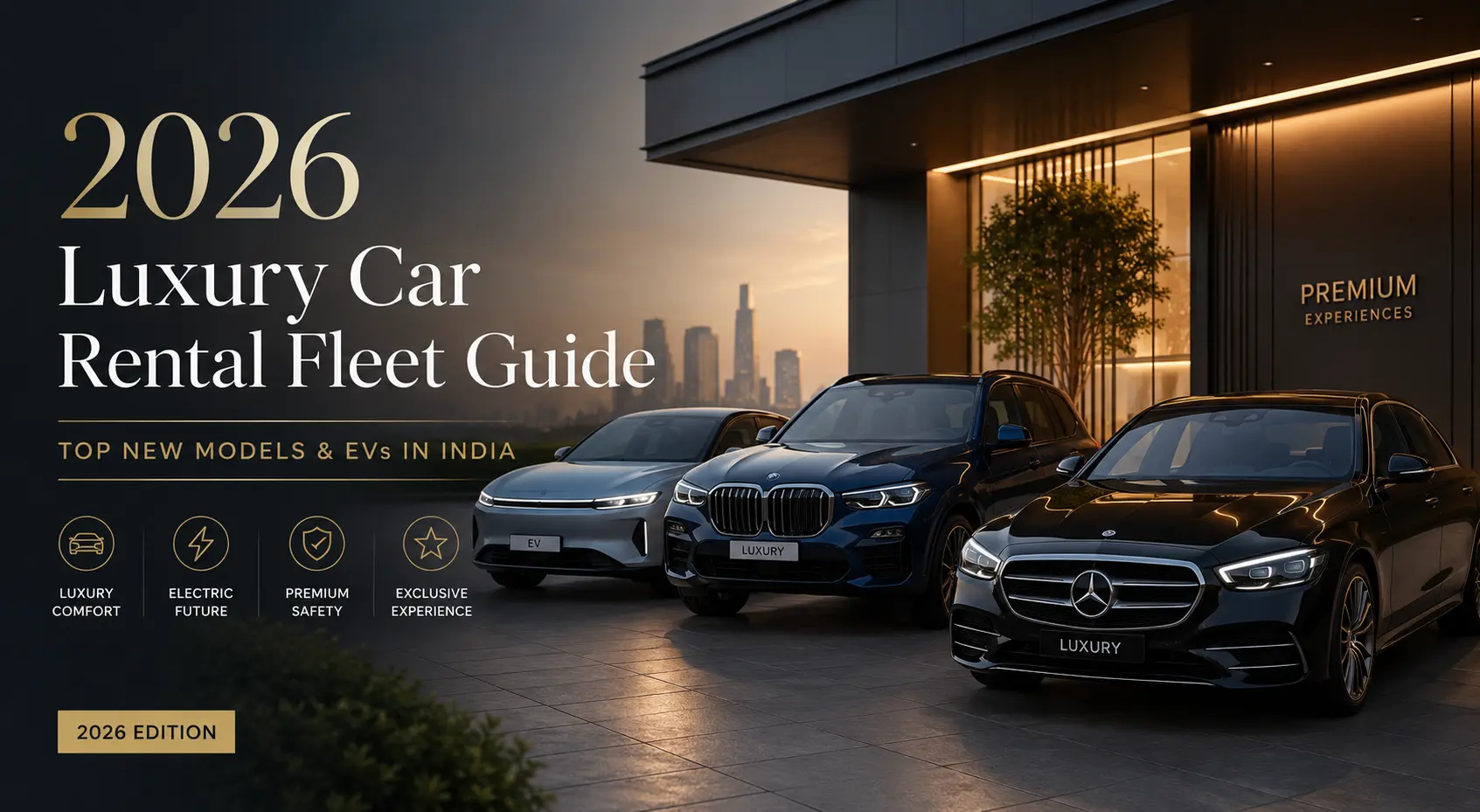
2026 is turning out to be one of the busiest years the Indian luxury car market has seen in a while. Mercedes-Benz alone has lined up around a dozen new launches, BMW has stepped up its rollout across new cities, and electric models that once felt experimental — the Mercedes EQS, BMW i7, even the electric G-Wagen — are now genuine options for chauffeur-driven travel rather than novelty test drives.
For anyone booking a luxury car rental or planning long-term corporate mobility, that shift matters. The fleet available today looks meaningfully different from what was on offer even two years ago, and EVs in particular have moved from a "nice to have" to a serious option for daily executive travel.
This guide walks through what's actually changing in India's luxury and electric fleet in 2026, and what each shift means if you're choosing a car for a wedding, an airport run, or a long-term corporate contract.
Why 2026 Is a Turning Point for Luxury Mobility in India
A few things are happening at once this year, and together they add up to a genuinely different fleet landscape than what existed even twelve months ago.
Mercedes-Benz has publicly committed to around twelve new product launches in India through 2026, spanning both top-end combustion models and new EVs. The brand has also begun local production of the Maybach GLS, making India only the second market in the world — after the United States — to build this flagship SUV, which has meaningfully improved availability and pricing on what used to be a strictly imported model.
BMW isn't far behind. The brand added nearly twenty new products across its lineup last year and continues expanding its physical showroom footprint into more Indian cities, a sign that demand for genuine luxury mobility is no longer concentrated only in Mumbai and Delhi.
The clearest shift, though, is in electric luxury. What used to be a handful of EVs aimed at early adopters has turned into a real, comparable segment — with serious range, serious tech, and serious presence — that increasingly gets chosen not as a compromise, but as the preferred option, especially for corporate and chauffeur-driven use.
The New Flagship Sedans Setting the Standard
The flagship sedan segment remains the benchmark for what "luxury" means in India, and 2026 has brought a meaningful refresh at the very top.
The Mercedes-Benz S-Class received a significant mid-cycle update this year, arriving with sharper technology, a larger central touchscreen, and the kind of refinement that's kept it the default choice for executive travel and VIP movements for decades. For anyone booking a car specifically for VIP arrivals and departures or board-level executive travel, the updated S-Class remains the single safest, most universally recognized choice.
Mercedes has also confirmed plans to bring a plug-in hybrid version of the S-Class to India — the first time the brand has offered this powertrain locally — giving buyers and renters a genuine middle ground between a traditional combustion flagship and a fully electric one, without sacrificing the presence the S-Class is known for.
BMW, meanwhile, is bringing back the X6 with a powerful V8 engine as part of its 2026 lineup, reinforcing that performance-oriented luxury SUVs still have a strong following in India even as the broader market shifts toward efficiency and electrification elsewhere.
The Electric Luxury Segment Has Genuinely Arrived
If there's one story defining 2026 in Indian luxury mobility, it's that electric vehicles have stopped being a compromise and started being a legitimate first choice — particularly for chauffeur-driven use, where range anxiety matters less than cabin comfort and presence.
The Mercedes-Benz EQS SUV sits at the top of this shift. With a 122 kWh battery, real-world range well above 550 kilometers, and the brand's 56-inch MBUX Hyperscreen dominating the cabin, it's increasingly recommended by industry reviewers as the top choice specifically for chauffeur-driven, HNI-focused travel — ahead of rivals like the Porsche Macan Electric and Audi Q8 e-tron — largely because of its rear-seat comfort and sheer road presence.
The BMW i7 takes a different, more theatrical approach to the same brief. Its standout feature is a 31-inch rear entertainment screen that drops from the ceiling, paired with a premium sound system — effectively turning the back seat into a private lounge. For premium mobility built around film and media production schedules or long-haul executive travel where passengers genuinely want to work or unwind en route, this kind of cabin experience has become a real differentiator, not just a gimmick.
At the more exclusive end, the Rolls-Royce Spectre represents the fully electric version of what the brand has always stood for — and its growing presence in India signals that even the most traditionally combustion-loyal buyers in the ultra-luxury segment are willing to make the switch, provided the presence and craftsmanship remain uncompromised. For clients specifically booking a Rolls-Royce for a wedding entrance or a landmark corporate event, this shift is worth knowing about even if the combustion version remains the more traditional choice for now.
On the more accessible end of the electric spectrum, RNK's own BYD E6 continues to serve a genuinely important role — proving that electric mobility doesn't have to mean paying a seven-figure premium to get a comfortable, quiet, chauffeur-appropriate ride for corporate and airport transfer use.
What's Changing for SUVs and MPVs
The luxury SUV and MPV segment — arguably the backbone of corporate and family travel bookings — has seen just as much movement as sedans this year.
The Mercedes-Benz GLS got its own Celebration Edition this year, priced north of four crore rupees, reinforcing its position as the flagship choice for buyers who want maximum presence and space without stepping down to a sedan. Alongside it, the newly locally-produced Maybach GLS has become meaningfully more accessible than before, opening up the ultra-premium SUV segment to a wider set of corporate and event clients than in previous years.
On the electric side, seven-seat luxury EVs have quietly become a genuine category rather than a handful of scattered options. The MG M9 has emerged as a dedicated chauffeur-driven luxury electric MPV, built specifically around rear-passenger comfort with a 90kWh battery and over 500 kilometers of certified range — a clear signal that manufacturers are now designing electric models specifically for the chauffeur-driven use case, not just adapting family SUVs.
For large-group event and gathering transportation, this expanding MPV and SUV segment — spanning the Mercedes V-Class, GLE, and larger coach options like the Toyota Coaster and Volvo 9600 — means there's now a genuinely well-matched vehicle for almost any group size, rather than forcing larger parties into oversized or undersized options.
Entry-Level Luxury Is Expanding Access to the Segment
One of the more significant shifts happening beneath the flagship headlines is the rapid growth of entry-level luxury — a segment that's making genuine luxury brands accessible to a much broader base of Indian buyers and corporate accounts.
Audi's third-generation Q3, BMW's next-generation 3 Series (alongside its new electric i3 variant), and Mercedes' new-generation CLA are all arriving in this window, each aimed at buyers stepping into a luxury brand for the first time. Industry analysts have pointed to rising disposable income and a genuine shift in consumer preference toward premium experiences as the driver behind this segment's growth, rather than it being a one-off trend.
For corporate clients evaluating monthly rental plans or comparing rental versus leasing for a broader employee mobility program, this expanding entry-level segment means more genuine luxury options are becoming available at price points that weren't realistic even two or three years ago.
What This Means for Choosing a Rental in 2026
With this much movement in the fleet landscape, the practical question for most renters isn't which car is objectively "best" — it's which model actually fits the specific occasion.
For classic executive and VIP travel where instant recognition matters most, the Mercedes S-Class remains the safest, most universally understood choice — it's the model every driver, hotel concierge, and event coordinator in India already knows how to accommodate.
For clients specifically prioritizing sustainability without compromising on comfort, the EQS SUV and its emerging rivals now offer a genuinely comparable experience to combustion flagships, not a scaled-down alternative — worth serious consideration for any corporate travel policy that's begun factoring in sustainability commitments.
For weddings and landmark events where the car itself is part of the moment, the Rolls-Royce and Mercedes-Maybach lineup continue to hold a category of their own — no EV yet fully replicates that specific kind of occasion-defining presence, though the Spectre is closing the gap faster than most expected even a year ago.
And for larger groups or families, the growing range of well-equipped seven-seat options — both combustion and electric — means there's finally a genuine choice at that seat count, rather than a single default option.
City-Wise Availability Is Becoming Less of a Constraint
For years, one of the quiet limitations of luxury and electric mobility in India was geography — the newest, most exclusive models were realistically available only in Mumbai and Delhi, with everywhere else waiting months for stock or settling for older variants.
That's genuinely shifting in 2026. Both Mercedes-Benz and BMW have publicly committed to expanding their physical showroom footprints into more cities this year, which has a direct knock-on effect for rental availability, since dealer presence and service infrastructure are usually what determines whether a fleet operator can realistically maintain a model outside the largest metros.
This matters most for clients booking travel in growing business hubs like Pune, Ahmedabad, Hyderabad, and Chandigarh, where demand for genuine executive-grade mobility has grown considerably faster than infrastructure has historically kept pace with. A city-wise comparison of Mumbai versus Delhi luxury rentals is still useful context, but the broader trend is that the gap between metro and non-metro availability is narrowing faster than it has in previous years.
Sustainability Commitments Are Starting to Shape Fleet Choices
A less visible but increasingly important shift in 2026 is how corporate sustainability commitments are starting to directly influence which vehicles get booked, not just which ones exist.
More corporate travel policies now include some form of emissions or sustainability consideration, even if it isn't yet a hard requirement. That's pushed EV options from a "nice signal" to book occasionally into a genuine default for companies that have made public sustainability commitments and want their day-to-day executive travel to visibly reflect that.
This shift lines up closely with what's covered in more depth in sustainable luxury mobility trends in India — the short version is that the improving range, comfort, and availability of models like the EQS SUV and BYD E6 have made it realistic, for the first time, to build an entire corporate mobility program around lower-emission vehicles without asking executives to compromise on comfort or brand presence to do it.
Frequently Asked Questions
Are luxury EVs actually practical for chauffeur-driven travel in India yet? Increasingly, yes. Range anxiety matters far less for chauffeur-driven use than for self-driven road trips, since these vehicles typically operate on predictable city and airport routes with access to charging between bookings. Cabin comfort, quiet operation, and smooth power delivery — all genuine EV strengths — matter more in this specific use case than outright range numbers.
What's the difference between booking a combustion flagship versus an EV flagship for an event? Presence and tradition still favor combustion models like the S-Class and Rolls-Royce for landmark occasions, largely because of how universally recognized they are. EVs like the EQS SUV and BMW i7 offer comparable or superior in-cabin technology and comfort, making them a strong choice when the priority is the passenger experience rather than the visual statement of the car itself.
Is it worth booking an entry-level luxury model instead of a flagship for routine corporate travel? For day-to-day executive transport and airport transfers, entry-level luxury models increasingly offer the comfort and brand credibility corporate travel needs, at a meaningfully lower cost than a flagship — the flagship's extra presence matters most for specific high-stakes occasions, not routine travel.
Will luxury EV availability outside Mumbai and Delhi catch up in 2026? It's moving in that direction. Expanding dealer and service networks from Mercedes-Benz and BMW into more cities this year directly supports better rental fleet availability outside the traditional metro strongholds, though the newest and most exclusive EV models will likely remain concentrated in the largest cities for at least another year or two.
The Bottom Line
2026 marks a genuine inflection point for luxury mobility in India — not just new model years, but a real expansion in what "luxury" can mean, from the continued dominance of the Mercedes S-Class to a maturing electric segment that's no longer a compromise for chauffeur-driven travel.
Choosing the right vehicle now comes down less to what's simply available, and more to genuinely matching the car to the occasion — something that's only gotten easier as the fleet options themselves have gotten better.
Looking for the right vehicle for your next event, corporate contract, or airport transfer? Explore the full RNK fleet or get in touch to plan it out.